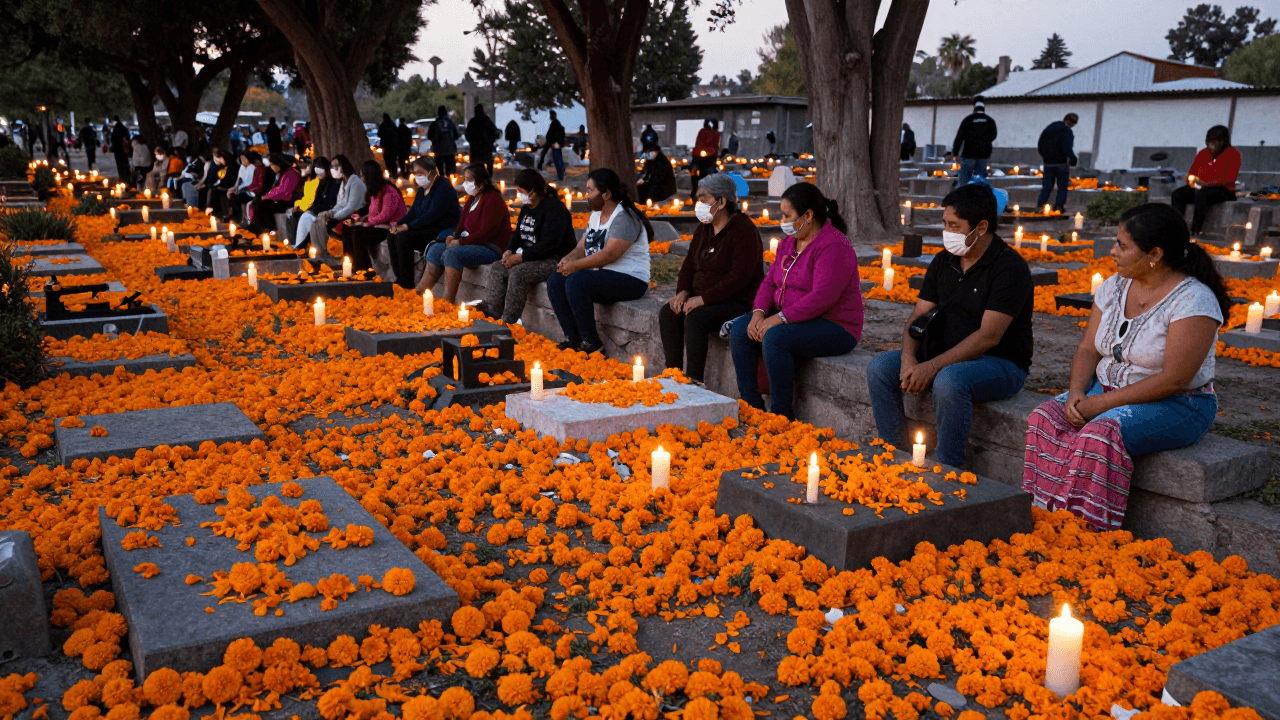
Picture people sitting in the middle of a cemetery. There is no mourning and no fear on their faces; they hold thermoses, they have blankets, and the gravestone in front of them is covered in orange flowers and dozens of candles. Someone tunes a guitar, a child bites into a small sugar skull. This is not a film set. It is an ordinary night of Día de Muertos, the Day of the Dead, in countless Mexican towns and neighbourhoods every 1 and 2 November.
As the end of October approaches, the tradition is often mentioned in the same breath as Halloween. They are very different things. On takvim.in we see this mix-up more than almost any other in events culture, so this post works through it question by question.
Key points
- Día de Muertos is celebrated on 1 and 2 November; the dead are believed to visit their families once a year.
- The tradition is not about scaring anyone. It is about remembering and hosting.
- UNESCO proclaimed it in 2003 and inscribed it on the Representative List of the Intangible Cultural Heritage of Humanity in 2008.
- At its centre are the ofrenda (memorial altar), orange cempasúchil marigolds and the favourite foods of the person remembered.
Is Día de Muertos Mexico's Halloween?
Short answer: no. Halloween is an evening of costumes, sweets and spooky aesthetics on 31 October. Día de Muertos is built around welcoming back loved ones who have died. Death here is not a threat but a guest who is still part of the family.
That the two sit side by side is no accident. Both are close to 1 November, All Saints' Day, in the Christian calendar. In Mexico that calendar meets a far older rhythm kept by Indigenous communities.
UNESCO's inscription page says as much: the festivity is practised by Mexico's Indigenous communities, marks the temporary return of deceased relatives, runs from late October into early November and completes the annual maize cultivation cycle. It describes a blend of pre-Hispanic rites and the Catholic feasts Europeans introduced in the sixteenth century.
Exactly where each piece comes from is debated. Some Mexican academics argue the pre-Hispanic roots are strong; others think the present form took shape much later. The honest answer is that it is neither a pure "Aztec ritual" nor a purely Spanish inheritance, but something blended over centuries.
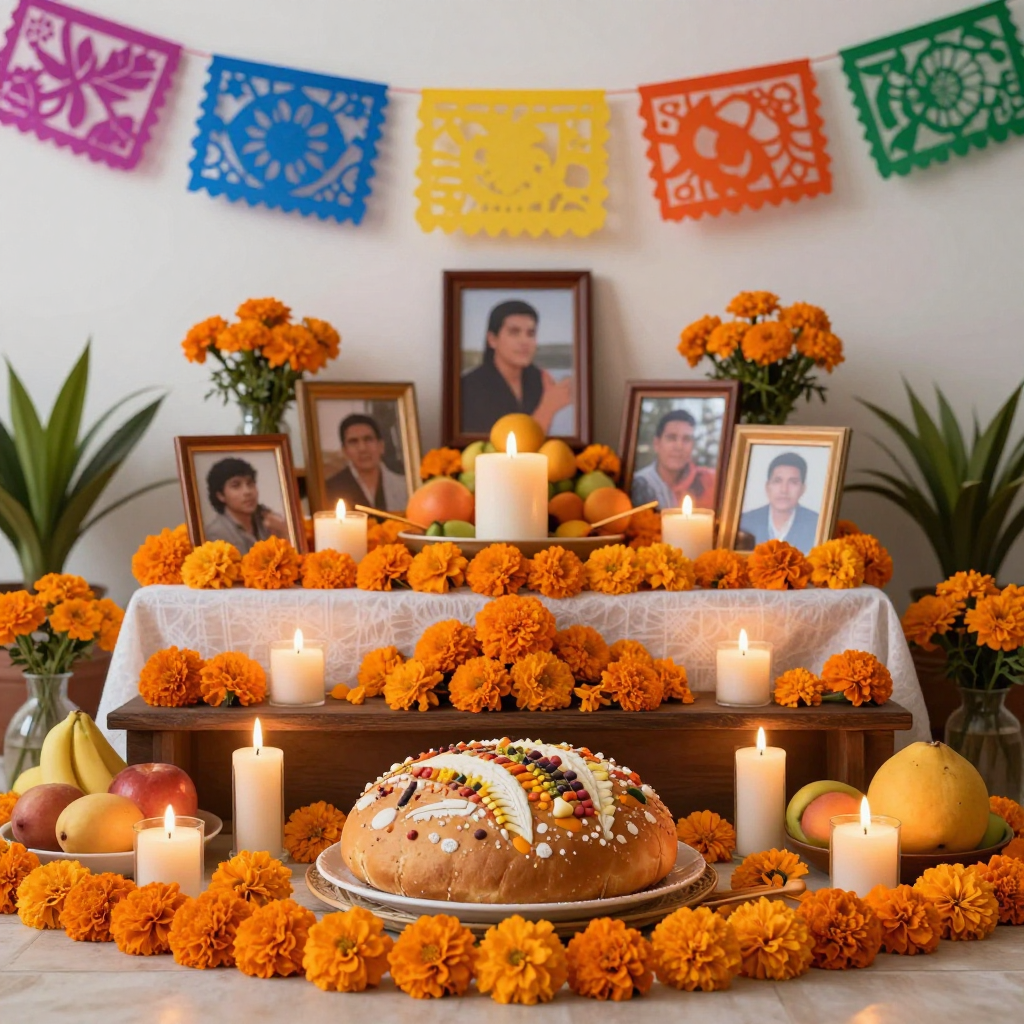
What is an ofrenda, and why does it matter so much?
An ofrenda is the memorial altar built at home or beside a grave. "Offering" is the literal translation, but the purpose is not to give something to a deity. It is to host the person who has died.
As UNESCO describes it, families guide the souls with flower petals and candles along the path from cemetery to house. The altar holds the deceased's favourite dishes, flowers and paper cut-outs (papel picado). A typical altar looks like this:
| Item | Meaning |
|---|---|
| Cempasúchil (marigold) | Its orange colour and scent are believed to guide souls |
| Candles | Light, direction, the souls' way home |
| Pan de muerto | Sweet bread with bone-shaped decorations, made for the occasion |
| Photographs | Tell the visitors whom the altar welcomes |
| Food and drink | Whatever the person loved in life |
| Papel picado | Paper banners that stir in the air |
One detail is striking: each of the dead has a day of their own. According to UNESCO, the day of remembrance depends on categories such as cause of death, age, sex and sometimes profession. In many regions 1 November is for children's souls and 2 November for adults, though details vary from place to place.
Where and how is it lived in Mexico?
It is not one single thing. A city parade and a lakeside village keeping a quiet all-night vigil are very different experiences.
Mexico City. The city's Day of the Dead parade was born more from cinema than from custom. Reports say the opening scene of the James Bond film Spectre (2015) suggested a huge parade of the dead already existed in the capital; it made such an impression that the parade was actually held for the first time in 2016. The main march usually runs along Paseo de la Reforma from the Estela de Luz to the Zócalo. Dates and routes can change from year to year, so check official announcements before you go.
Mixquic. The cemetery of this neighbourhood south of the capital is known for its candlelit "Alumbrada" on the night of 2 November. Graves are covered in orange marigold petals and families spend the night beside them.
Janitzio. On this island in Lake Pátzcuaro, Michoacán, thousands of candles are lit and the island glows across the water. It has become a busy tourist site, but for the families who keep vigil there, it is still a genuine night of remembrance.
What they share is that the cemetery stops being only a place of grief and becomes a meeting place. There is music, shared food, and stories.
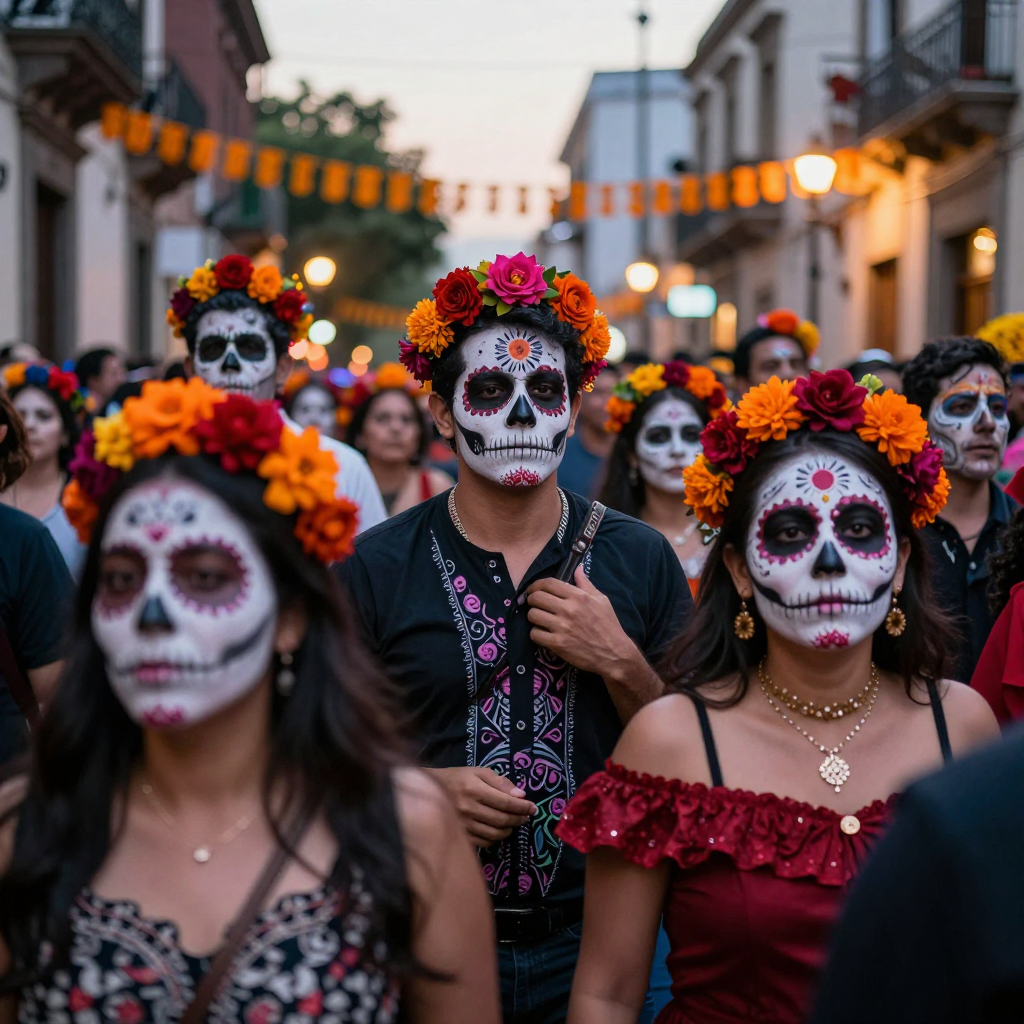
Why so many skulls, and who is La Catrina?
Sugar skulls (calaveras de azúcar), bone-themed bread and cartoon skeletons form the visual language of Día de Muertos. Much of it is a way of laughing at death, humanising it rather than making it monstrous. Reminding everyone that they end up as a skeleton is also a joke that erases class differences.
The best-known figure is La Catrina. The elegantly hatted skeleton drawn by the Mexican printmaker José Guadalupe Posada in the early twentieth century became a symbol of the festivity, and Diego Rivera later fixed her in a mural. The people who wear white-and-black face paint and flower crowns at celebrations today are echoing that figure.
One distinction matters: skull make-up is not a costume but a form of respect. If you are an observer at a ceremony with local families, it is good practice to ask before photographing someone in face paint.
What would you do if you were in Mexico that day?
Pick the setting first. The Mexico City parade is crowded and staged; neighbourhood cemeteries like Mixquic are denser and more intimate. They suit different people; if you want a quiet experience on the night of 2 November, go early and find a corner among the crowd.
Dress comfortably but without showiness, since nights can be cool. Do not touch altars, flowers or offerings at a cemetery. Instead of stepping in front of an ofrenda for a photo, stay a step back and ask first.
Finally, prices and crowds climb quickly in these days, so accommodation and transport need to be planned months ahead. We deliberately give no prices here because they change every year.
How did pop culture change the tradition?
Film has done a great deal to make the tradition known worldwide. We mentioned Spectre above; Pixar's Coco (2017) then explained family, remembering and the meaning of the ofrenda to millions of children. Its central idea is that the dead truly go once they are forgotten, and that is exactly the logic of Día de Muertos: remembering postpones death.
Popularity has a cost. As the tradition becomes a tourist spectacle, there are places where it collides with the communities' own practice. If you visit an Indigenous village in Mexico the rule is simple: be quiet, slow down when passing families at graves, and do not take close-up photos without permission.
Is there anything like it in our own culture?
There is no direct equivalent, but there are familiar echoes. In Turkey, visiting cemeteries on the eve of a holiday, cooking halva after a death, handing out lokma or food, and remembering the dead on kandil nights all point to a culture that does not cut ties with the dead at once. The difference is that in Mexico this is colourful, loud and openly cheerful, while in Turkey it usually takes a quiet, prayer-centred form.
This comparison is not a ranking. It is interesting to see how different societies answer the same question: how do our bonds with the dead continue?
Frequently asked questions
When is Día de Muertos celebrated?
Every year on 1 and 2 November. UNESCO notes that preparations and rites begin in late October and run into early November.
Is it the same as Halloween?
No. Halloween is a costume-and-fright celebration on 31 October; Día de Muertos is a tradition of lovingly hosting the dead.
What is pan de muerto?
A sweet bread made for Día de Muertos, decorated with bone-shaped pieces of dough; it is placed on the altar and also eaten.
Can I experience this in Turkey?
Mexican cultural centres, art venues and communities in big cities may occasionally hold memorial-themed exhibitions and workshops. You can search for current events on takvim.in, but do not assume one exists unless you see it listed.
A closing thought
The easiest way to understand Día de Muertos is to see it not as a party but as a family reunion. As the calendar nears the end of October, knowing what the tradition is makes it easier to look at it with both admiration and respect.