On the last night of the year, more than a million people are said to crowd the shores of Sydney Harbour, people in Madrid stand in a square with twelve grapes in their hands, and in Edinburgh strangers link arms to sing a song Robert Burns wrote down in 1788. The date is the same; the rituals could hardly differ more. At takvim.in we follow recurring occasions like this one, and New Year's Eve is the biggest of them all: the only celebration that moves around the planet one time zone at a time.
Key takeaways
- New Year's Eve is 31 December, the night before 1 January, the first day of the Gregorian calendar used by most of the world today.
- Ancient Rome started counting years on 1 January in 45 BC under the Julian calendar; the Gregorian reform of 1582 fixed the calendar's drift but kept that date.
- Traditions differ sharply: twelve grapes in Spain, first-footing and Auld Lang Syne in Scotland, a lit ball in New York, two fireworks shows in Sydney.
- In Turkey the Gregorian calendar was adopted on 26 December 1925, so 1 January 1926 was the first official new year; the national lottery draw and the decorated new-year tree are now part of the picture.
- The celebration rolls across the globe over about 26 hours, from Kiribati's Line Islands to Baker Island.
Why is New Year's Day on 1 January?
It is not a law of nature. Nothing in the sky marks 1 January: it falls about ten days after the December solstice and has no astronomical meaning. The date is a political convention. In the old Roman calendar the year began in March, and Roman officials, the consuls, took office on 1 January. When Julius Caesar reformed the calendar, the new Julian calendar took effect on 1 January 45 BC, and the year began on that day. The Julian calendar, designed with the help of the astronomer Sosigenes of Alexandria, used a 365-day year with a leap year every fourth year.
That system was slightly too long: it overestimated the solar year by roughly eleven minutes. Over centuries the mistake added up to about ten days. In 1582, under Pope Gregory XIII, a new calendar prepared with the Jesuit astronomer Christopher Clavius removed ten days from that year and refined the leap-year rule so that only one in four century years remains a leap year. That is the Gregorian calendar, the civil calendar of most countries today. Different countries switched at very different times: Catholic Europe quickly, Britain and its colonies only in 1752, Turkey in 1925. Many communities also keep other new years, such as the lunar new year or the Islamic Hijri new year, which fall on other dates. This post is about the shared, international 1 January.
Who celebrates first, and who is last?
Because of time zones, New Year's Eve is less a single night than a wave. Kiribati's Line Islands, including Kiritimati (Christmas Island), sit at UTC+14 and see midnight first. That is a modern arrangement: in December 1994 Kiribati moved the Line Islands from UTC-10 to UTC+14, so the whole country would share one calendar day. Among the last places are the uninhabited Baker and Howland islands in UTC-12. The gap between UTC+14 and UTC-12 is 26 hours, so for a full day somewhere on Earth it is already, or still, New Year's Eve.
What happens at Spain's twelve grapes?
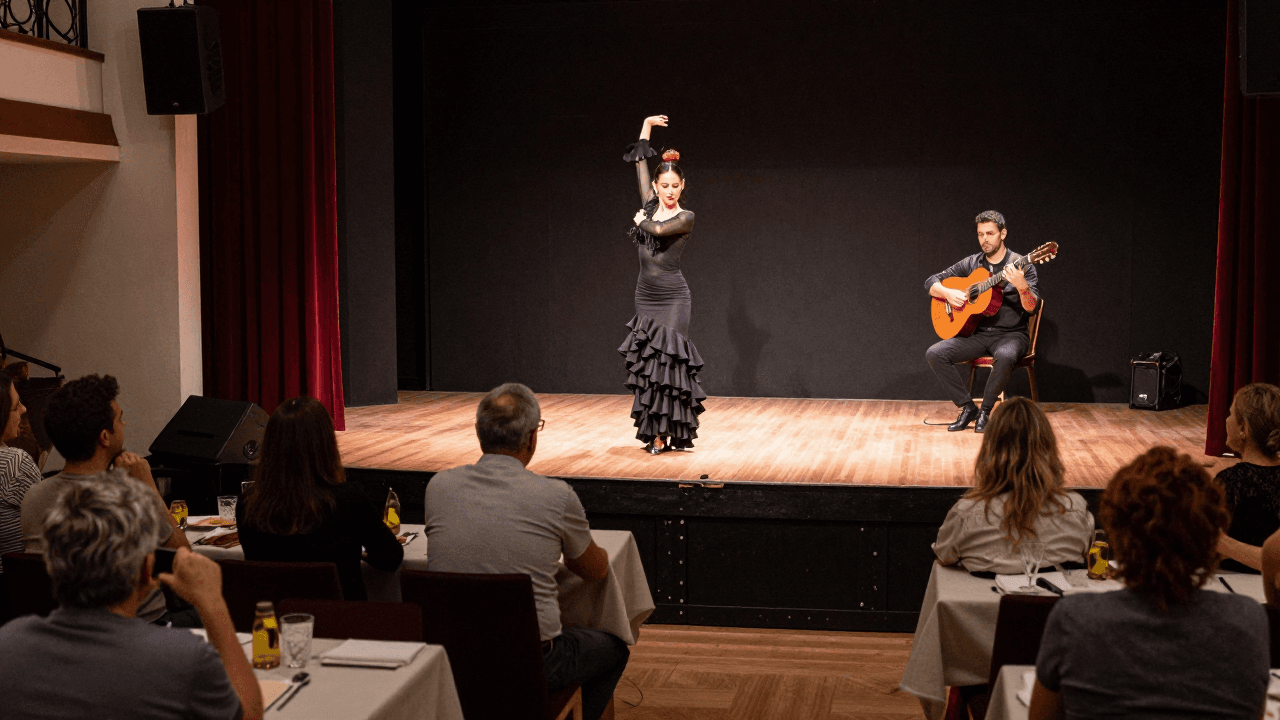
In Spain the countdown is eaten. As the clock chimes twelve times, people swallow one grape per chime, each meant to bring luck for one month of the coming year. The most famous setting is the clock at Puerta del Sol in Madrid, watched by a crowd in the square and by many more on television, but families do it at home too.
The origin is disputed. One widely repeated account says winegrowers in Alicante, facing an excellent harvest and a surplus, promoted the custom in 1909; the tradition is also documented from at least 1895. Another story traces it to the 1880s, when Madrid's working classes mocked the upper classes' imitation of the French habit of grapes and champagne at midnight. The honest summary: the custom is at least well over a century old, and nobody agrees on exactly how it began. The grapes are eaten fast, twelve in twelve strokes, which is harder than it sounds and part of the fun.

What is Hogmanay and first-footing in Scotland?
Hogmanay is the Scots word for New Year's Eve, and in Scotland it is arguably a bigger occasion than Christmas has historically been. After the Protestant Reformation, Christmas was frowned upon: the Scottish Parliament banned it in 1640, the ban was lifted in 1712, and Christmas became a public holiday in Scotland only in 1958. For centuries Hogmanay was therefore the main winter celebration.
Its best-known custom is first-footing: the first person to cross your threshold after midnight sets the tone for the year. Tradition prefers a tall, dark-haired visitor bearing symbolic gifts such as coal, shortbread or whisky. A common explanation, though not one that can be proven, links the preference for a dark-haired visitor to fears of fair-haired Viking raiders. The song of the night is Auld Lang Syne, based on a traditional ballad that Robert Burns wrote down in 1788 and later reworked; people cross arms and join hands for the final verse. Edinburgh turns this into a multi-day festival with concerts, street parties, a torchlight procession and fireworks over the Castle. On 1 January, swimmers in fancy dress take a plunge into the Firth of Forth at South Queensferry, a tradition called the Loony Dook that began informally in 1987.
What is the Times Square ball drop?
New York's version is a countdown watched by crowds and by television audiences. The story starts with the New York Times, which moved into its new tower on Times Square and celebrated the opening on New Year's Eve 1904, when a large crowd gathered (figures of more than 200,000 are often quoted). Fireworks were later banned for safety reasons, so in 1907 the paper introduced a ball: about five feet across, made of iron and wood, roughly 700 pounds, lit by 100 bulbs, lowered by hand from a pole. It has dropped every year since, apart from 1942 and 1943, when wartime lighting restrictions cancelled it. The drop itself is short, just a minute, and it is the crowd, packed behind barriers for hours in December cold, that is the show.
How does Sydney do New Year's Eve?
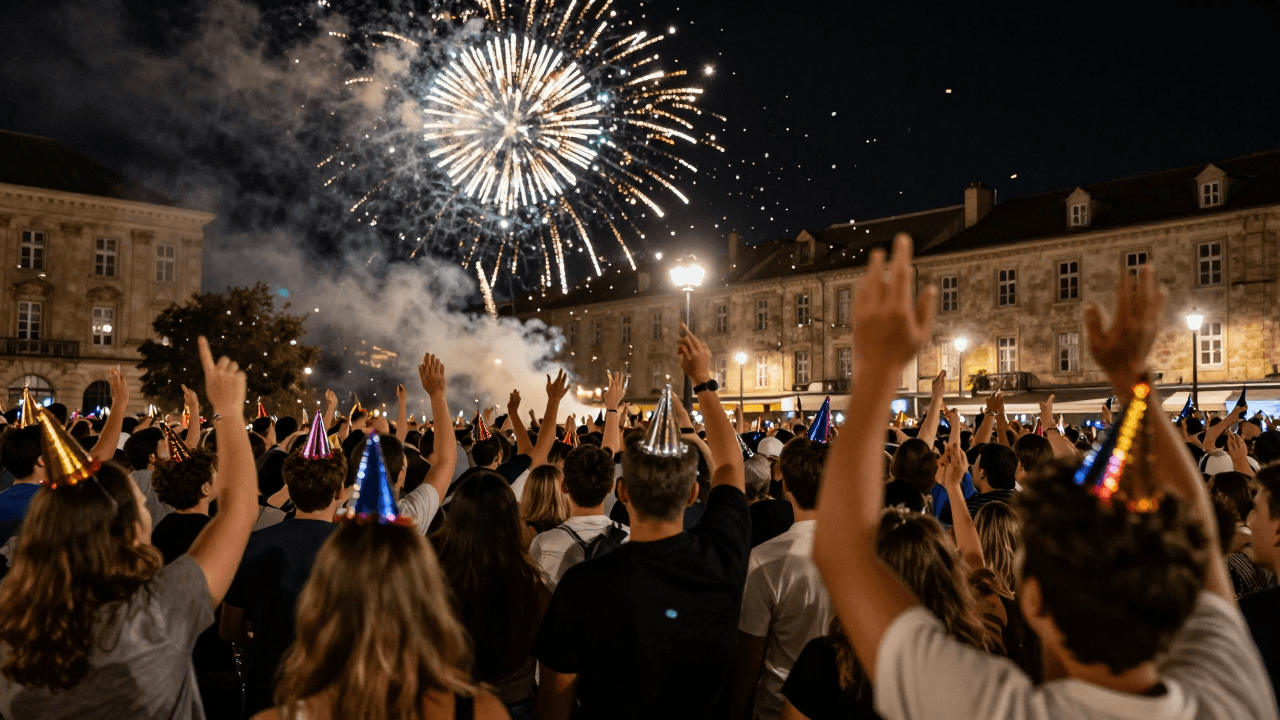
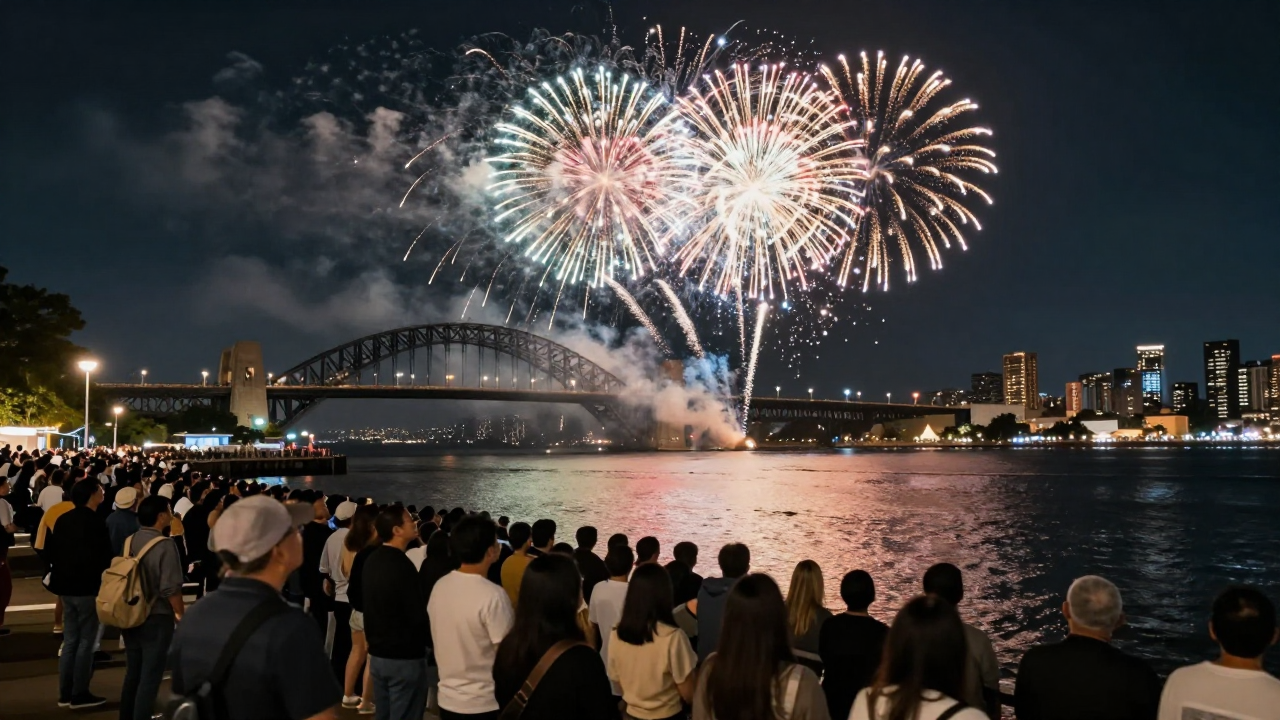
Sydney's harbour fireworks are one of the most watched images of the new year. The modern format dates to 31 December 1976, when the city decided that New Year's Eve should launch a new summer festival with a sail-past of decorated boats and a fireworks display at midnight. Today there are two shows: an earlier one at 9 p.m., aimed at families and children, and the main midnight display. The fireworks are launched from barges on the harbour and from landmarks including the Opera House and the Harbour Bridge, which serves as the focal point. Published figures put attendance at around 1.6 million people in recent years, though counts of this kind are estimates.
Quick comparison
| Place | Signature custom | Some facts |
|---|---|---|
| Spain | Twelve grapes at the twelve chimes | Documented from at least 1895; popularised in 1909 by Alicante growers, by one account |
| Scotland | First-footing, Auld Lang Syne, Loony Dook | Christmas ban 1640, lifted 1712; Burns wrote the song down in 1788 |
| New York | Ball drop in Times Square | First ball 1907, about 700 pounds; paused 1942 and 1943 |
| Sydney | 9 p.m. and midnight fireworks | Modern format from 1976; roughly 1.6 million spectators cited |
| Kiribati | First midnight on Earth | Line Islands moved to UTC+14 in 1994 |
How is Yılbaşı celebrated in Turkey?
The Turkish word is Yılbaşı, literally "head of the year". Turkey adopted the Gregorian calendar on 26 December 1925, so 1 January 1926 was the first date to be treated as the start of the year. Accounts of that first celebration describe a Friday night party and the tradition of the city's electric company switching off the lights for a minute at midnight; 1 January became an official holiday in 1936. Historians describe the shift as part of the early republic's Westernising reforms.
Today the picture in most cities is a home dinner with family or friends, often with a turkey on the table, games such as tombala (Turkish bingo), a decorated new-year tree called the yılbaşı ağacı, gift exchanges, and a countdown on television. Restaurants, concert halls and venues stage special programmes and outdoor squares host concerts and fireworks. The biggest cultural fixture is the Milli Piyango (national lottery) new-year draw. The Milli Piyango administration began operating in 1939 and held its first draw on 11 November 1939; according to the administration's history, the first special new-year draw came in 1941, with tickets sold at one lira. Buying a ticket and waiting for the draw remains a small national ritual, even for people who never win.
How can you experience New Year's Eve well?
A few practical thoughts that hold almost anywhere. Choose your scale: a huge public crowd (Sydney, Edinburgh, New York) means long waits, road closures and security checks, so arrive early and plan how you will get home. A smaller neighbourhood concert, a dinner or a quiet home gathering offers a different kind of night. If you want the local custom, pick one and do it properly: twelve grapes rather than twelve tastes of everything. Whichever you choose, book early; venues fill fast in the last week of December.
In Istanbul, small stages in neighbourhoods such as Kadıköy program piano recitals, family shows and children's plays around the new year, a reminder that the night does not need a mass event to be memorable.
FAQ
Why do people kiss or sing at midnight?
Practices vary by place. Singing Auld Lang Syne at midnight is a Scottish custom that spread to many English-speaking countries; a kiss at midnight is a widespread habit in Western countries, usually explained as a wish for a good year with the people closest to you. Neither is universal.
Is New Year's Eve the same date everywhere?
For countries using the Gregorian calendar, yes: 31 December. But because of time zones, the moment of midnight arrives over about 26 hours. Communities that use other calendars celebrate their own new years on other dates.
Why do Spaniards eat twelve grapes?
Each grape stands for a month, eaten one per chime of the clock at midnight. The custom is documented from at least 1895 and became widespread in the early twentieth century; the precise origin is contested, with a marketing story from Alicante in 1909 as one of the leading explanations.
When was the first Yılbaşı celebration in Turkey?
Turkey adopted the Gregorian calendar on 26 December 1925, so the first new year on the new calendar began on 1 January 1926; celebrations started that year, and 1 January became an official holiday in 1936.
Conclusion
New Year's Eve looks different in every place because it does very different jobs: a marketing success in Alicante, a defiant winter feast in Scotland, a newspaper's publicity stunt in New York, a harbour spectacle in Sydney, a modern Turkish family ritual. What they share is the wish to mark a clean break with the year behind us. If you would like to see what is on near you when the last week of December comes around, browse the listings at takvim.in and pick the size of night you want.