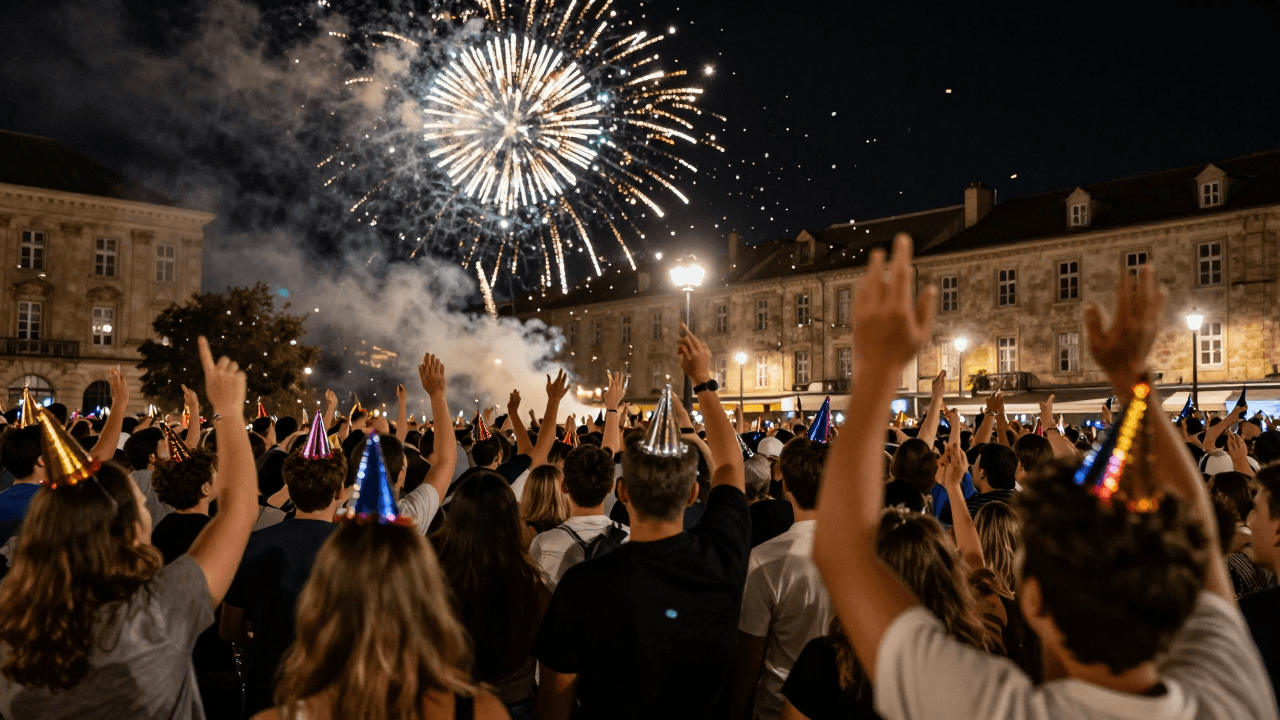
The first chord lands on the guitar, a single voice rises above it, and palms strike out a rhythm that feels older than the room: anyone who hears flamenco live for the first time usually notices the audience go quiet. Istanbul has hosted flamenco nights for years; in 2022, for example, the theatre hall of the Instituto Cervantes in Kadıköy put on a free flamenco recital. Every 16 November, Flamenco Day marks why this art is more than a show. At takvim.in we wanted to explain where the day comes from and what flamenco is actually made of.
Key takeaways
- 16 November marks the anniversary of UNESCO's 2010 inscription of flamenco on the Representative List of the Intangible Cultural Heritage of Humanity.
- Flamenco rests on three elements: cante (song), baile (dance) and toque (guitar playing), joined by hand-clapping, foot-stamping and sometimes castanets.
- Andalusia in southern Spain is its heartland, with roots in Murcia and Extremadura too. The Gitano (Romani) community played an essential role in its development.
- The many styles are called palos; each has its own rhythmic pattern and mood, and sources count more than fifty.
- In November Andalusia fills with events, while cultural centres and dance schools elsewhere hold their own concerts and classes.
- You do not have to travel to Spain to see a flamenco night; many cities, Istanbul among them, host live shows at certain times of year.
What is International Flamenco Day, and why 16 November?
The day traces back to a decision taken on 16 November 2010. That day UNESCO's Intergovernmental Committee for the Safeguarding of the Intangible Cultural Heritage, meeting for its fifth session in Nairobi, Kenya, inscribed flamenco following a submission by Spain. The decision carries the reference 5.COM 6.39 in UNESCO's records. Each year on 16 November, fans, schools, cultural institutions and artists mark the anniversary.
A word on the day's official status, since it is easy to overstate. The core of the celebration is Andalusia: the regional culture department, through the Andalusian Institute of Flamenco, puts together a broad programme every November. In one recent edition it consisted of roughly a hundred performances, classes and exhibitions across the region's eight provinces, while flamenco clubs (peñas) staged dozens of performances on their own circuit. Elsewhere the day is shaped less by a central organiser than by cultural centres, Spanish institutes, dance schools and venues acting on their own initiative. So "International Flamenco Day" is best read as the common name for a date that has spread beyond its home region.
UNESCO's own description is short but instructive. It defines flamenco as an artistic expression fusing song, dance and musical performance. It names Andalusia as the heartland, notes roots in Murcia and Extremadura, and singles out the Gitano community as having played an essential role in its development. It also explains how the art survives: through dynasties, families, social groups and flamenco clubs. In other words this is not a museum piece. It is a living tradition learned in kitchens, courtyards and at weddings, from one generation to the next.
What exactly is flamenco?
Flamenco is not one type of song or one dance. It is a tradition in which three arts are locked together, and each has its own word:
- Cante: the song, or the singing. The singer is a "cantaor" (feminine "cantaora"). The rawest emotional layer of flamenco is often felt here.
- Baile: the dance, performed by a "bailaor" or "bailaora". It is not decoration; the footwork (zapateado), arms and torso are in conversation with the rhythm of the song.
- Toque: guitar playing, by a "tocaor". The guitar carries both harmony and rhythm, follows the singer and the dancer, and sometimes challenges them.
Around this trio come palmas (hand-clapping), pitos (finger snaps), foot-stamping and, at times, castanets and the cajón. The audience is not outside the process either: jaleo, the shouts of encouragement such as "olé" or "that's it!", counts as part of the performance. Flamenco talks back to its listeners.
One more term matters: compás, the rhythmic cycle every musician shares. Many flamenco styles are built on a 12-beat cycle, and the position of the accented beats changes from style to style. In a soleá the accents cluster on 3, 6, 8, 10 and 12, while a seguiriya stresses 12, 2, 4, 7 and 10. To an outsider this sounds tangled, but knowing that the rhythm follows a fixed structure makes a concert far easier to follow.
Where does flamenco come from?
There is no document that marks flamenco's birth. Historians generally agree that it took shape in the late 18th century in the towns and cities of Lower Andalusia. One of the oldest known written mentions dates to 1774, in José Cadalso's book Cartas marruecas (Moroccan Letters). Jerez de la Frontera is often cited as the place of the first written traces.
The word itself has a curious history. "Flamenco" was first used to describe the Romani people of Spain; its application to the music goes back to around 1847, when a newspaper called it a "gitano genre". As for the roots, the Andalusian tourism authority describes a heritage born of centuries of exchange among the Greeks, Romans, Christians, Jews and Muslims of the southern Iberian Peninsula, with the influence of the Romani people arriving in the late 18th century. That is a summary of a broad cultural blend, not an exact family tree, so pinning flamenco on a single origin is misleading.
Its rise as a profession came in the second half of the 19th century. In 1881 Silverio Franconetti opened the first "café cantante" (singing café) in Seville. Professional singers took the stage there, competition grew, and flamenco acquired much of its present shape. The years 1920 to 1955 are often called the era of "flamenco opera" or a golden age, when big shows were staged in bullrings and theatres. La Niña de los Peines and Manolo Caracol are among the names associated with it.
What is a palo?
In flamenco a "palo" is a style, and it defines the rhythm, tone and emotional register, and often the region it grew from. Sources count more than fifty palos, which are usually sorted into two broad families:
| Family | Mood | Some examples |
|---|---|---|
| Cante jondo ("deep song") | Slow, serious, anguished, inward | Soleá, seguiriya, tiento, tango, saeta, malagueña |
| Cante chico ("small song") | Lighter, brighter, playful | Alegrías, bulería, fandango, guajira, verdiales |
The line is not absolute, and many styles sit somewhere in between, but it gives a first-time listener a working map. The soleá is often described as a cornerstone of the art, slow and grave. The seguiriya is harsher and more dramatic. Alegrías, as the name suggests, is bright; it is associated with the port city of Cádiz. The bulería is fast and full of rhythmic play, which is why it turns up at the end of a night and in improvised moments.
A simple tip for newcomers: rather than trying to catch one palo, read the names in the programme. A running order such as "soleá, tarantas, bulería" tells you the evening travels from a weighty opening to a lively finish.
What happened at the 1922 Cante Jondo contest?
One of the best-known moments in flamenco history is the 1922 Concurso de Cante Jondo in Granada. The poet Federico García Lorca and the composer Manuel de Falla organised it to preserve and dignify the deepest forms of flamenco. Festive styles such as cantiñas were excluded because the organisers did not consider them "jondo". Winners included El Tenazas and eight-year-old Manuel Ortega, who later became known as Manolo Caracol.
The event showed that flamenco could interest poets and composers as well as a narrow circle of insiders. It also opened a debate that continues today: what counts as pure, and what counts as innovation. Later in the century Paco de Lucía opened the guitar to Brazilian music, Arabic influences and jazz, and brought the Peruvian cajón into flamenco groups, while Camarón de la Isla became a symbol of renewal through his voice. In the 1970s and 1980s flamenco fusion met rock, blues and pop. Today artists such as Rosalía blend flamenco with urban rhythms and reach listeners worldwide.
What happens at a flamenco recital?
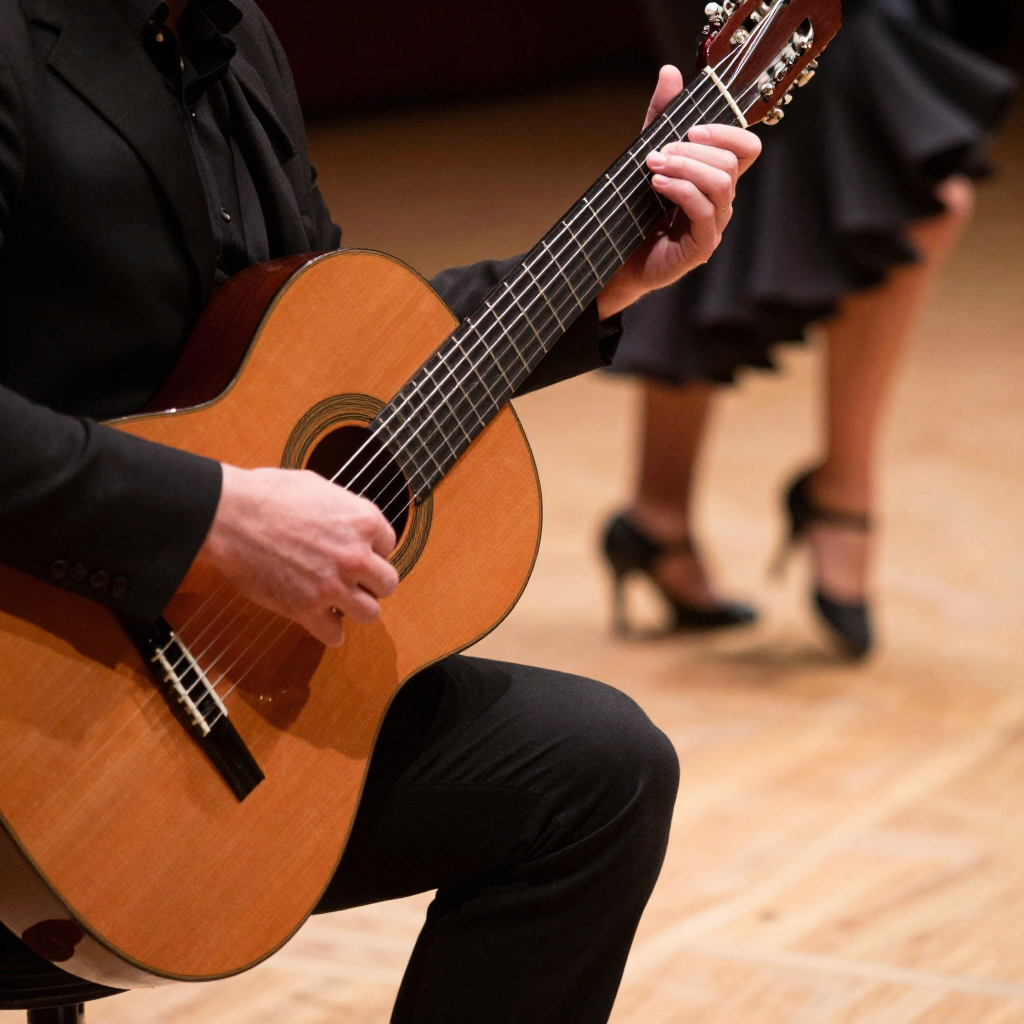
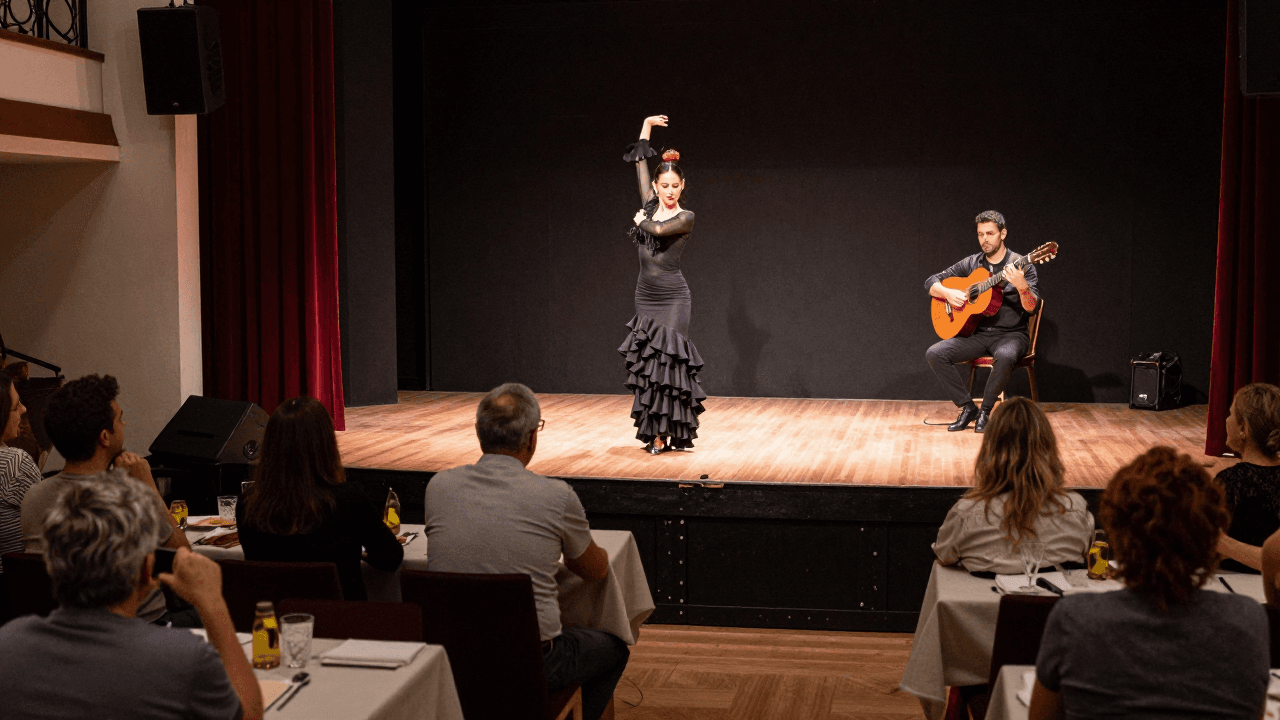
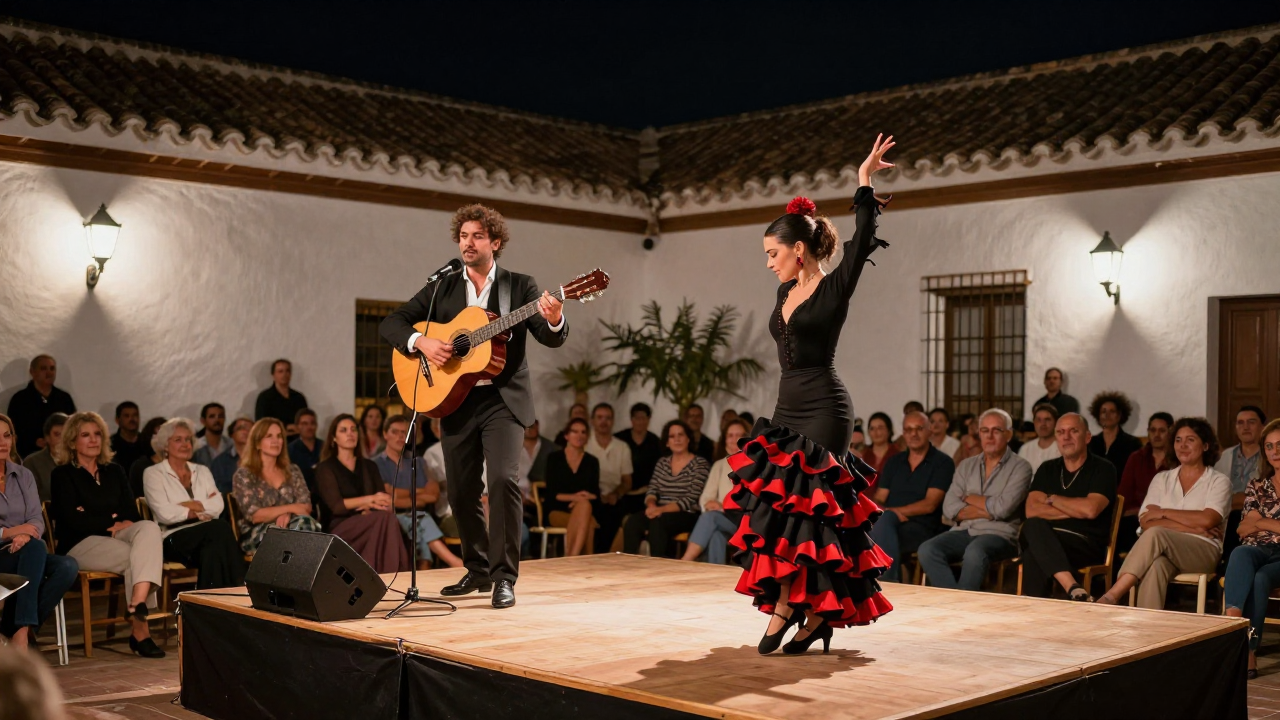
A flamenco recital may not resemble a classical concert at all. Many shows open with the guitarist alone; the singer joins, and the dance enters depending on how the song unfolds. Moving straight from one palo to the next, or improvising on the spot, is normal.
Take an Istanbul example. In 2022 the theatre hall of the Instituto Cervantes Istanbul hosted a free recital in which guitarist Kerem Can Özpekel, who comes from an Istanbul family of musicians, was joined by Rafael Jiménez "Rafita" on cante, Sara Sánchez on dance and Adrián Jiménez on percussion. Inspired by Özpekel's album Cuatro Naranjas, the programme featured bulerías, tarantas, soleás, seguiriyas and rumbas, along with a piece rooted in Turkish musical tradition. It was a good illustration of how flamenco today is not only an Andalusian stage art but one that can talk with other musical traditions.
The settings you may meet include:
- Tablao: a venue with a small stage devoted to flamenco, with or without dinner.
- Peña: a flamenco club run by enthusiasts, which often programmes free or low-cost shows.
- Theatre or cultural centre: bigger, more formal concerts.
- Family gatherings and celebrations: as UNESCO notes, flamenco is also performed at religious festivals, ceremonies and private celebrations.
How can you take part in Flamenco Day?
If you are in Andalusia, programmes multiply through November in Seville, Cádiz, Jerez, Granada and smaller towns, and peñas run their own circuits. If you live elsewhere, options are more modest but real. A few routes to try:
- Check the November listings of Spanish cultural institutes, universities and cultural centres near you.
- Look for open classes or showcases at flamenco dance studios in your city.
- Read up on the palos in a programme beforehand; a rough map for your ears adds to the enjoyment.
- If it is your first time, focus on the cante. Even without Spanish you can feel what the voice carries.
Flamenco nights are scattered and hard to track in one place. A calendar such as takvim.in helps here: you can browse arts, music and culture events city by city and see where a style of event has been held in past years.
What sets Flamenco Day apart from other cultural days?
Many world days are known for a slogan. Flamenco Day is the anniversary of a decision, and that decision is meant to protect a living practice. The items on UNESCO's list are not stones or buildings but people's knowledge, skill and practice. So marking 16 November usually means going to a concert, taking a lesson or watching a guitarist's hands up close.
| Feature | Flamenco Day |
|---|---|
| Date | 16 November (every year) |
| Basis | UNESCO intangible heritage inscription, 2010 |
| Where decided | Nairobi, Kenya (Intergovernmental Committee, fifth session) |
| Heartland | Andalusia, Spain |
| Elements | Cante, baile, toque |
| Format | Concerts, classes, exhibitions, peña programmes |
Frequently asked questions
When is Flamenco Day?
Every year on 16 November, the anniversary of UNESCO's 2010 inscription of flamenco on its intangible heritage list.
Is flamenco only dance?
No. Flamenco consists of cante (song), baile (dance) and toque (guitar), with hand-clapping and foot-stamping as part of the rhythm. Dance is only one face of the whole.
What is a palo, and how many are there?
A palo is a flamenco style, meaning a pattern of rhythm and mood. Sources count more than fifty. Soleá, seguiriya, alegrías and bulería are among the best known.
Can you enjoy flamenco without speaking Spanish?
Yes. Understanding the lyrics adds depth, but emotion, rhythm and dance travel across languages. Reading the palo names and a short translation beforehand is a good start.
Conclusion
Flamenco is too broad to celebrate in a single day, but 16 November is a good excuse to listen to it for the first time. To see the centuries of history and the living tradition of a guitar, a voice and a pair of feet, check the programmes in your city, and to find music and culture events near you, visit takvim.in.