Every year on 14 February, florists sell out of red roses, restaurants fill every table for two, and someone somewhere sits down to write a card by hand. Yet the man whose name the day carries is one of the murkiest figures in church history, and the romance attached to him arrived roughly a thousand years after his death. On takvim.in we keep track of concerts, dinners and small cultural evenings around this date, and the most interesting thing about them is how many different ideas of "love" they contain.
Key takeaways
- Valentine's Day honours at least one, possibly two, early Christian martyrs named Valentine; the famous stories about secret weddings and a farewell note are later legends, not documented history.
- The link between 14 February and romantic love first appears in the poet Geoffrey Chaucer's Parliament of Fowls, written in the 1380s, where birds choose their mates.
- The popular claim that the day replaced the Roman festival of Lupercalia is contested; the historian Henry Ansgar Kelly has argued there is no evidence for it.
- Around the world the day looks very different: in Japan women traditionally give chocolate to men and men answer on White Day, 14 March; in Finland and Estonia it is a day for friends.
- In Turkey, where it is called Sevgililer Günü, it is often marked with dinners, gifts and concerts, including programmes that mix Turkish and Western love songs.
Who was Saint Valentine?
The honest answer is that nobody is quite sure. The church remembers at least two men called Valentine on 14 February. One is a priest in Rome, traditionally said to have been martyred in 269 CE and buried on the Via Flaminia, the old road leading north out of the city. The other is Valentine, bishop of Interamna, today's Terni in Italy, whose martyrdom is placed in 273 CE during the reign of the emperor Aurelian. Historians still debate whether these are two men, one man remembered in two places, or a mixture of local memory and legend.
The uncertainty was serious enough that in 1969 the Roman Catholic Church removed Saint Valentine from its General Roman Calendar, the list of feasts observed by the whole church. The reasoning is quoted often: apart from his name, nothing is known of him except that he was buried on the Via Flaminia. He can still be honoured locally. The Eastern Orthodox Church keeps its own dates for Saint Valentine, 6 July and 30 July.
The best-known stories are attractive but come from much later tradition. In one, the emperor Claudius II bans marriage for young soldiers because he wants them focused on war, and Valentine marries couples in secret. In another, he heals or befriends the daughter of his jailer and signs a last note "from your Valentine". These stories explain why we love the day, but you should read them as legend. If a guide or a greeting card presents them as settled fact, be gently sceptical.
Did Valentine's Day really replace Lupercalia?
You will often read that the church invented Valentine's Day to replace Lupercalia, an ancient Roman festival held in mid-February, and that Pope Gelasius I did so around 496 CE after condemning the older festival in the 490s. It is a tidy story, and it is also the part most historians distrust.
The trouble is that the evidence stops where the story begins. A feast of Saint Valentine on 14 February is recorded in the Gelasian Sacramentary, a liturgical book from the 8th century, but nothing in the sources ties that feast to Lupercalia's rituals, and nothing in Lupercalia's rituals is about romantic love in the way we now mean it. Henry Ansgar Kelly, a scholar of the medieval church and of Chaucer, observed that there is no evidence linking Saint Valentine's Day to Lupercalia customs, despite the popularity of the claim. February was simply a month when a lot of things were remembered, and a martyr's feast day landed on the 14th.
So a fair summary is this: Lupercalia was real, Saint Valentine was probably real, and the idea that one was built on top of the other is a modern-sounding explanation that the sources do not support.
How did 14 February become a day for lovers?
The turning point is literary, not religious. In the 1380s the English poet Geoffrey Chaucer wrote The Parliament of Fowls (in Middle English, Parlement of Foules), a dream poem in which birds gather to choose their mates. Chaucer sets it on a specific day: "For this was on seynt Valentynes day", the poem says, when every bird comes to choose a partner. Wikipedia and many literary historians date the poem to around 1382, and most treat it as the first recorded link between Valentine's Day and romantic love. The likely explanation is medieval belief that birds paired off in mid-February, but that is an interpretation, not a fact Chaucer states.
After Chaucer the idea spread through court poetry. The earliest surviving valentine poem in French was written in 1415 by Charles, Duke of Orléans, who was held in the Tower of London after being captured at the Battle of Agincourt. He addressed his wife as "ma tres doulce Valentinée", my very sweet valentine, and complained of being already tired of love. A prisoner writing to someone he could not see is a reasonable candidate for the first true valentine.
The next big step was industrial. Around 1847 in Worcester, Massachusetts, Esther Howland (1828 to 1904) began producing embossed paper-lace valentine cards in numbers, which turned a private gesture into a product you could buy. A great deal of what we now consider the traditional celebration, cards, flowers and chocolates, is therefore a story of the last two centuries.
How is Valentine's Day celebrated around the world?
The date is shared, but almost nothing else is. The following comparison shows a few of the clearest differences.
| Place | Name or custom | What happens |
|---|---|---|
| Japan | Valentine's chocolate and White Day | Women give chocolate on 14 February; men return gifts on 14 March |
| South Korea | Black Day, 14 April | Single people gather to eat black noodles |
| Finland | Ystävänpäivä ("Friend's Day") | Friends exchange cards and small gifts; couples take part too |
| Estonia | Sõbrapäev ("Friend's Day") | The same idea, adopted at the end of the 1980s |
| Turkey | Sevgililer Günü | Dinners, flowers, gifts and themed concerts |
Japan: chocolate, obligation and White Day
Japan reversed the Western script. Here the day is about women giving chocolate to men. The most widely accepted origin is a 1936 advertisement placed by the Kobe confectioner Morozoff in the English-language newspaper Japan Advertiser, dated 12 February, suggesting that readers send chocolates as Valentine's gifts. In 1953 the firm added heart-shaped chocolates to its campaign.
Over the decades the custom developed its own vocabulary. Honmei choco is chocolate for a partner or someone you truly love; giri choco, from giri meaning social obligation, is chocolate given politely to colleagues, bosses and acquaintances. The return gift comes on 14 March, White Day, which is often said to have begun in 1977 when Ishimura Manseido, a confectioner in Fukuoka, promoted marshmallows for men to give back. Popular accounts add that the return gift should be worth two to three times the original, but that is a rule of thumb, not a law.
Finland and Estonia: a day for friends
In Finland the date is Ystävänpäivä, Friend's Day. It began in the 1980s, partly as a school tradition in which children made cards and small handmade gifts, and it entered the Finnish calendar officially in 1996. People celebrate with cards, shared meals and outdoor activities such as skating or sledding, and both singles and couples take part. The idea reached neighbouring Estonia at the end of the 1980s, where it is called Sõbrapäev.
South Korea and the 14th of every month
South Korea observes Black Day on 14 April, when people without a partner eat black noodles together. It is a good example of how a single date can be stretched into a whole calendar of small rituals, and it shows that a romantic holiday quickly produces a holiday for everyone left out of it.
Turkey: Sevgililer Günü
In Turkey the day is known as Sevgililer Günü, "the day of sweethearts". It is observed with dinners, flowers, chocolates and gifts, and cities such as Istanbul run themed concerts and evenings. Exactly when the custom arrived in Turkey is not clearly documented, so it is safer to say that it is now widely known than to guess a date. Turkish already has a rich tradition of love poetry and song, and that is why Valentine's programmes there often sound different from a generic playlist of pop ballads.
What does a Valentine's concert look like in Istanbul?
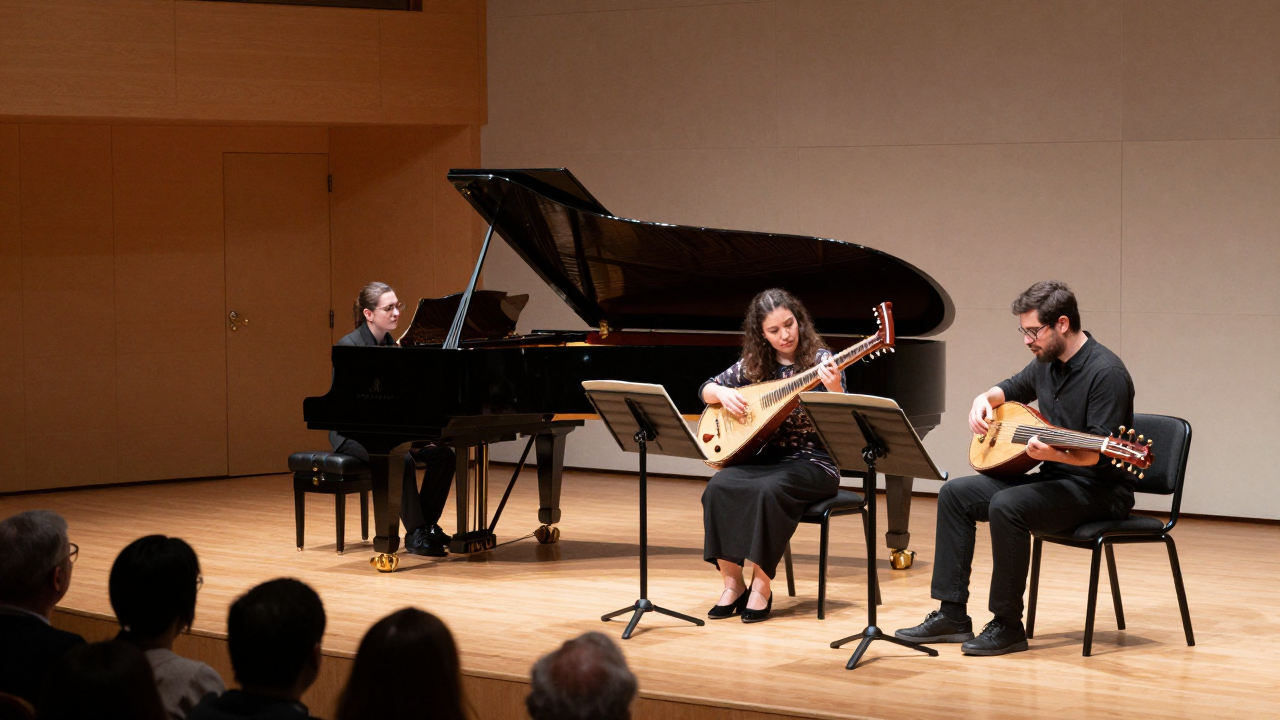
A concrete example comes from 2020, when Yeldeğirmeni Sanat, a venue in the Rasimpaşa area of Kadıköy on Istanbul's Asian side, hosted a Valentine's programme called "Her Dilde Aşk", or "Love in Every Language". It was performed by faculty from the Okan University State Conservatory: Dr. Çetin Körükçüoğlu and Dr. Göknil Bişak Özdemir in the field of Turkish music, and Dr. Seta Kürkçüoğlu in opera singing. Paolo Villa played piano and Fatih Vural played the kanun, a plucked trapezoid-shaped zither central to Turkish classical music.
The idea was simple and clever: put Turkish music and Western music on the same stage and let love songs from East and West answer each other. It is a good model for anyone planning the day. A concert like that gives a couple, a group of friends or someone attending alone a shared reason to sit in the same room, with none of the pressure of a restaurant reservation.
What can you do on 14 February besides dinner?
The history above suggests some useful ideas. If Chaucer's day was for choosing companions and Charles of Orléans wrote his valentine as a letter, the day has always been about attention more than spending. A few approaches that follow from it:
- Go to something live. A concert, a reading or a small theatre show gives you something to talk about afterwards.
- Take the Finnish idea. Call the friend you have not seen for months. Nothing in the history says the day belongs only to couples.
- Write something by hand. Charles of Orléans did it from a prison cell, so a short handwritten note is in good company.
- Book early, or go on the 13th. Popular restaurants fill up around the date, and many venues schedule special evenings in the days before and after.

FAQ
Is Valentine's Day named after a real person?
Probably yes, but we know very little about him. The church honours at least one martyr called Valentine, and traditions place two of them in Rome and Terni, in the 3rd century. The famous stories about secret weddings and a signed farewell note are later legends.
Did Valentine's Day replace a Roman festival?
That is the popular claim, linking the day to Lupercalia and Pope Gelasius I, but it is contested. Scholars such as Henry Ansgar Kelly say there is no evidence for it. The connection with romantic love comes from medieval literature, especially Chaucer.
Why do women give chocolate in Japan on 14 February?
The custom is usually traced to a 1936 chocolate advertisement by the confectioner Morozoff and later spread through department stores and the confectionery trade. Men return the favour on White Day, 14 March, a custom often traced to 1977.
Is 14 February only for couples?
No. In Finland and Estonia it is Friend's Day, and in South Korea single people have their own Black Day on 14 April. Even in couple-focused countries, many people use the date to thank friends and family.
Closing thoughts
A day with an unclear saint, a fourteenth-century poem about birds and a nineteenth-century card factory has room for many ways of celebrating, and that is probably why it has lasted. If you would like to spend it hearing music rather than reading a menu, or find something happening near you this week, you can browse what is on at takvim.in.