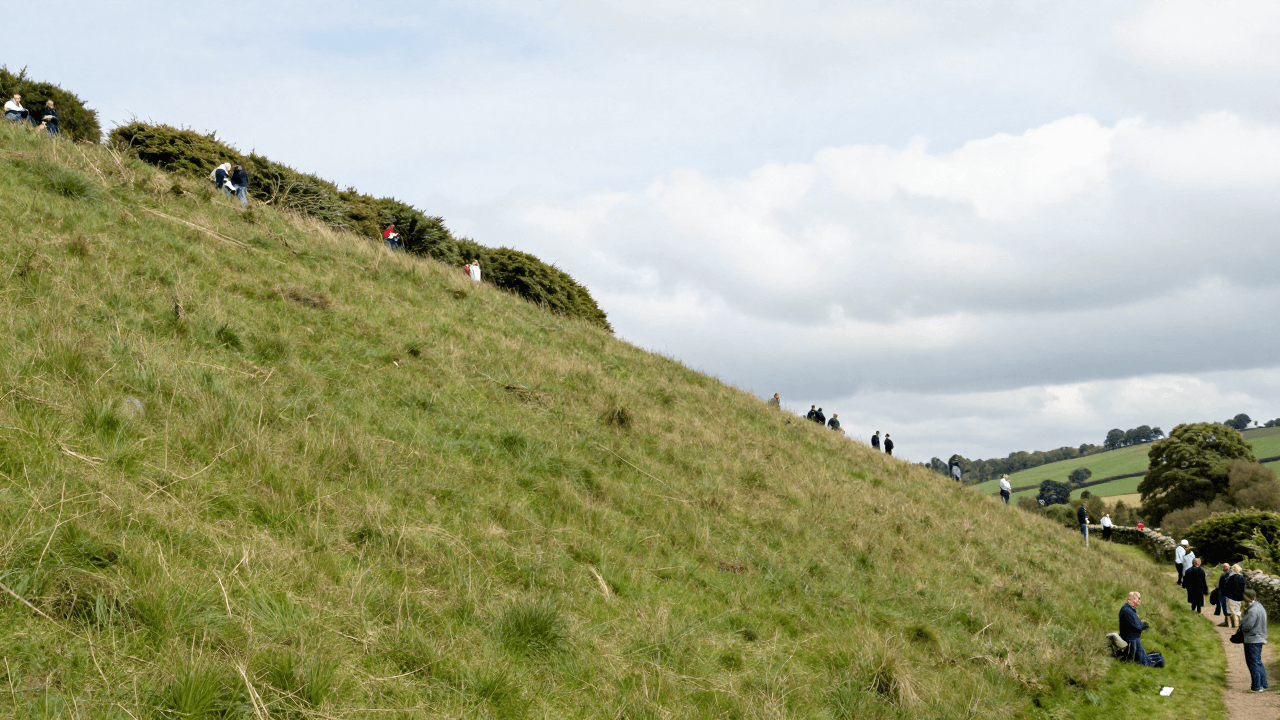
At the top of a steep Gloucestershire hill, a crowd waits for a signal. A wheel of cheese is sent bouncing down the slope, and a second later dozens of people launch themselves after it. Most never get their feet under them. This is the Cooper's Hill Cheese-Rolling, one of the strangest races in the world, and on takvim.in it belongs on any list of recurring occasions worth understanding before you decide whether to go and watch. Here is where it comes from, how it works today and what you should know.
Key takeaways
- The Cooper's Hill Cheese-Rolling and Wake is held at Brockworth, near Gloucester, usually on the Spring Bank Holiday Monday at the end of May.
- A Double Gloucester cheese of roughly 3 to 4 kilograms (7 to 9 pounds) is rolled down the hill, and racers start about a second behind it. Nobody realistically catches it, so the first person over the finish line wins.
- The slope is about 200 yards (180 metres) long with a gradient of around 50 percent in places, and most runners fall.
- The official, organised event ended in 2010. It has continued unofficially since: free, with no registration, and with real risk.
- Winners now come from around the world: in 2026 the three men's downhill races went to a German, a Dutchman and an American.
What is the Cooper's Hill Cheese-Rolling?
It is a race down a hill after a rolling cheese. Cooper's Hill sits just above the village of Brockworth, a few miles south-east of Gloucester. The full name is the Cooper's Hill Cheese-Rolling and Wake; "wake" is an old English word for a local village festival, which tells you the race began as part of a community celebration rather than as a sporting fixture.
On paper the aim is to catch the cheese. In practice the cheese gets a one-second head start on a very steep slope and is often quoted as reaching about 70 mph (roughly 112 km/h). That figure is a widely repeated estimate, not a measured record. Whoever crosses the bottom line first wins, and the cheese goes to the winner as the prize.
Where does the cheese-rolling come from?
Nobody knows for certain. The BBC has reported theories that the custom may go back at least 600 years, but that is speculation rather than evidence. The written record is much shorter, and sources disagree slightly on where it starts. The commonly cited first written trace is a message to Gloucester's town crier printed in Berrow's Worcester Journal on 9 June 1836. National Geographic gives 1826 as the first recorded roll, and the BBC mentions suggestions that the custom began about ten years before the 1836 record. The safe reading is that there are at least two centuries of documented history, and anything earlier is tradition.
The date has moved too. The event was once held around Midsummer, then on Whit Monday (the day after Pentecost in the Christian calendar), and in 1967 it shifted to the Spring Bank Holiday, the last Monday of May. That is why it now feels like a bank holiday outing rather than a religious-calendar fixture.
How does the race work today?
A typical day includes several races. The downhill races are split by gender, and a day usually has three men's races and one women's race. There are also uphill races, generally for children, with categories such as "under 11" and "11 and over" in recent years. To run the downhill races you need to be over 18.
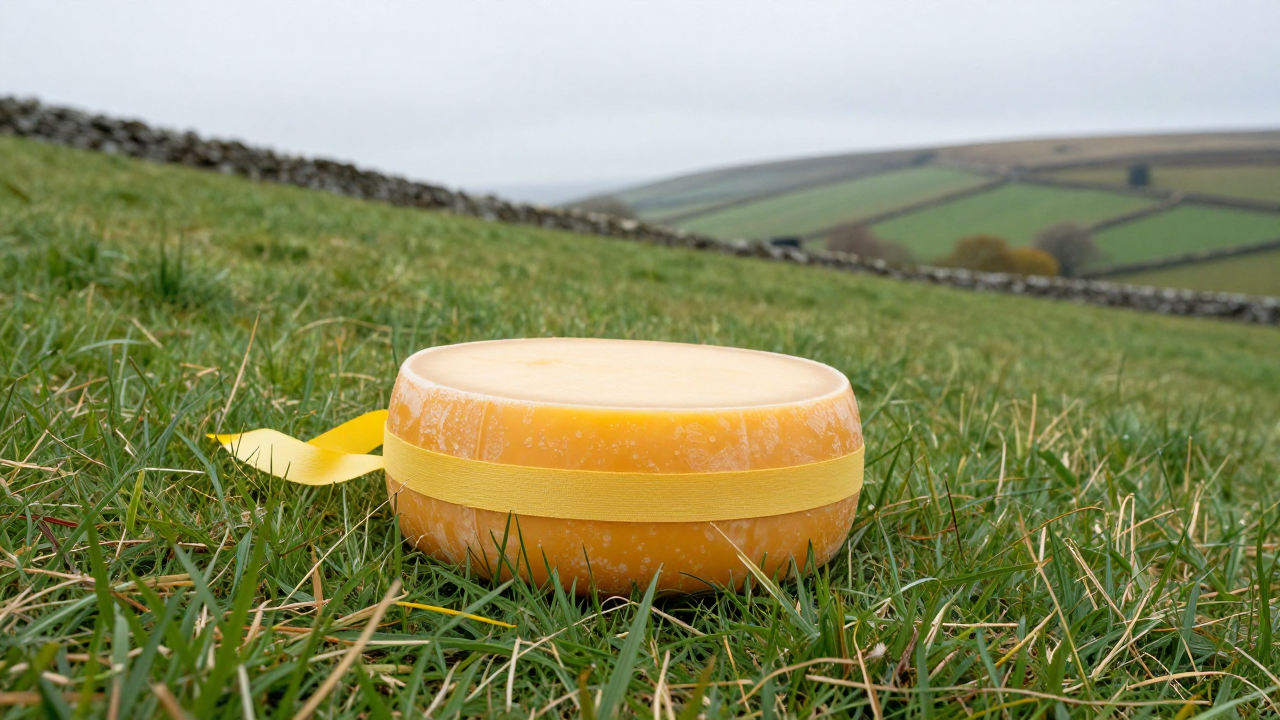
The cheese is Double Gloucester, a hard cheese traditionally made in a round shape in Gloucestershire. Since 1988 it has been supplied by Diana Smart and her son Rod from a farm in Churcham. Sources give the weight as 7 to 9 pounds, about 3 to 4 kilograms. For rolling, it is fitted with a wooden protective case and decorative ribbons.
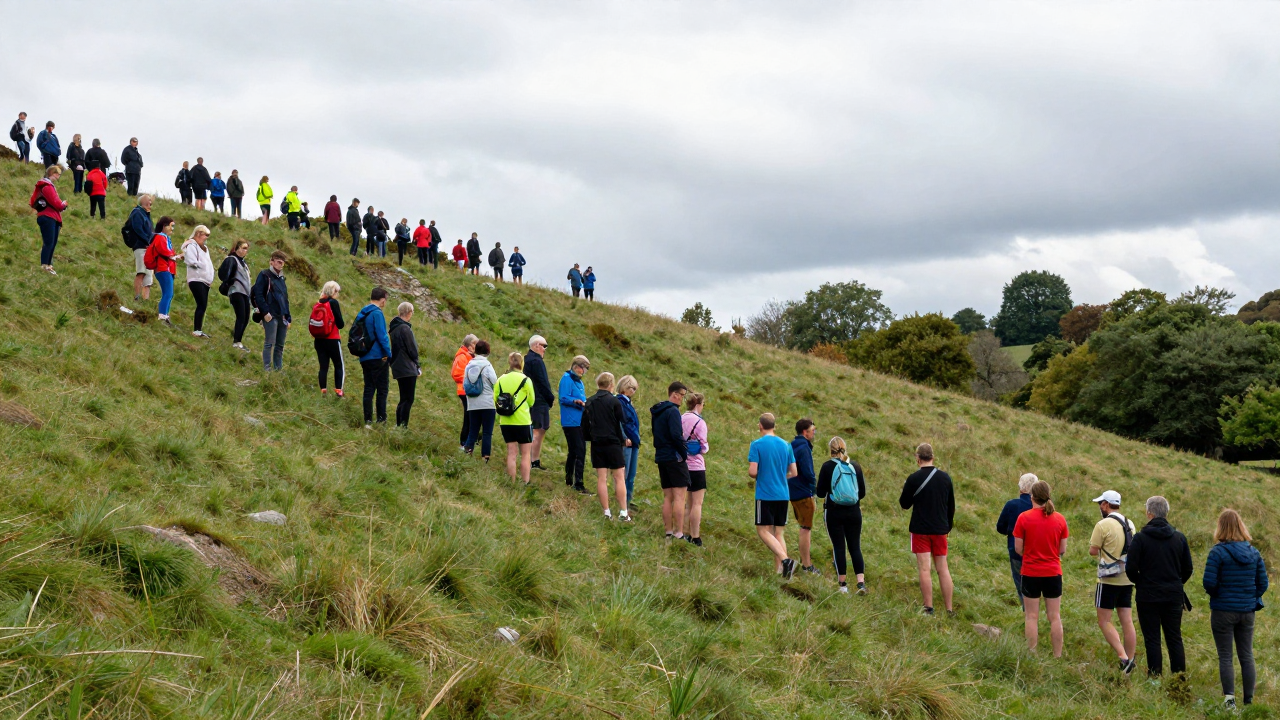
The mood on the hill is festive even though the course is not. Crowds gather around the slope, competitors gather at the top, and after each descent the racers climb back up to watch the next race. The whole spectacle is over quickly: a single run down the hill takes only seconds, and in 2023 the fastest recorded time was 13 seconds, set by American Cooper Cummings.
Why is the event unofficial?
For many years the race was run with local organisation and first-aid cover from St John Ambulance. In 2010 the official event was cancelled. According to Wikipedia the reason was crowd safety: about 15,000 spectators arrived at a site with a capacity of around 5,000. Even so, roughly 100 people held an unofficial race. In 2011 a proposal for a two-day ticketed event was dropped after public backlash, and around 200 people took part in an unofficial race.
The situation is much the same today. No organisation runs a festival. Volunteers and people committed to the tradition keep it going. There is no registration, admission is free and everyone takes part at their own risk. Injuries make the news every year. In 2023, for example, Canadian racer Delaney Irving won the women's race while unconscious and learned of her victory in the medical area; six competitors were taken to hospital by ambulance that day.
Who has won?
The records are as remarkable as the tradition. In the men's downhill, Chris Anderson holds the record with 23 wins between 2005 and 2022, after which he retired. Before him, Stephen Gyde (21 wins between 1976 and 1991) and Steven Brain (17 between 1984 and 2000) dominated. In the women's race Flo Early has the most wins with four (2008, 2016, 2018 and 2019).
Recent first-race and women's results:
| Year | Men's first race | Women's race |
|---|---|---|
| 2023 | Matt Crolla (UK) | Delaney Irving (Canada) |
| 2024 | Tom Kopke (Germany) | Abby Lampe (USA) |
| 2025 | Tom Kopke (Germany) | Ava Sender Logan (UK) |
| 2026 | Tom Kopke (Germany) | Ariel Dempsey (USA) |
2026 was also a first in the recorded history of the race: all men's downhill races were won by non-British competitors, from Germany (Tom Kopke), the Netherlands (Niels Wennemars) and the United States (Otto Linkogle). Winners over the years have also come from Australia, Belgium, Canada, Egypt, Japan and New Zealand. A village custom has become an international curiosity.
Why does it survive?
There is no single answer. Part of it is stubbornness: when official permission fell away, locals and enthusiasts simply carried on. Part of it is the image, hundreds of people watching runners fail to stay upright on a slope with a wheel of cheese below. And part of it is the simplicity: the rules fit into one sentence, get to the bottom first, whether you fall or not.
Wikipedia records that a lightweight foam cheese was used in 2013 for safety reasons and that the real cheese returned in 2014. In 2020 and 2021 the races were cancelled because of the COVID-19 pandemic, and the event came back on 5 June 2022. Those small episodes show the two sides of the tradition: an effort to make things safer, and a reluctance to let it go.
How can you experience it?
Entry to the hill needs no ticket, but finding space and getting up the slope is up to you. Footwear and ground conditions matter because the grass can be slippery. Take the warning that the cheese is not controlled seriously, for racers and for anyone standing on the slope below. This is not a relaxing day out.
Check the date each year: in 2026 the event fell on Monday 25 May. Staying in Gloucester or Cheltenham and travelling to Brockworth is sensible, but roads and parking are busy that day, so leave early. When you plan bank holiday weekends, a calendar such as takvim.in is a good place to look for other seasonal events near you.
FAQ
When is the Cooper's Hill Cheese-Rolling held?
Usually on the Spring Bank Holiday Monday at the end of May; in 2026 it was 25 May. The date changes each year, so confirm before you go.
Does anyone actually catch the cheese?
Rarely. It starts a second ahead and moves fast. The winner is the first person across the finish line, and the cheese is the prize.
Do you need to register to take part?
No. The event is unofficial, admission is free and there is no registration. You must be over 18 for the downhill races, and there are uphill races for children.
Is it dangerous?
Yes. The slope is very steep and uneven, and injuries happen every year. If you think of taking part, decide knowing the risk. Watching is not entirely risk-free either.
Conclusion
The Cooper's Hill Cheese-Rolling is more than a list entry for odd races. It is a village tradition kept alive by stubbornness, and it still belongs to the slope at Brockworth. To find festivals and events near you, browse takvim.in, and see what else the calendar has for the season.