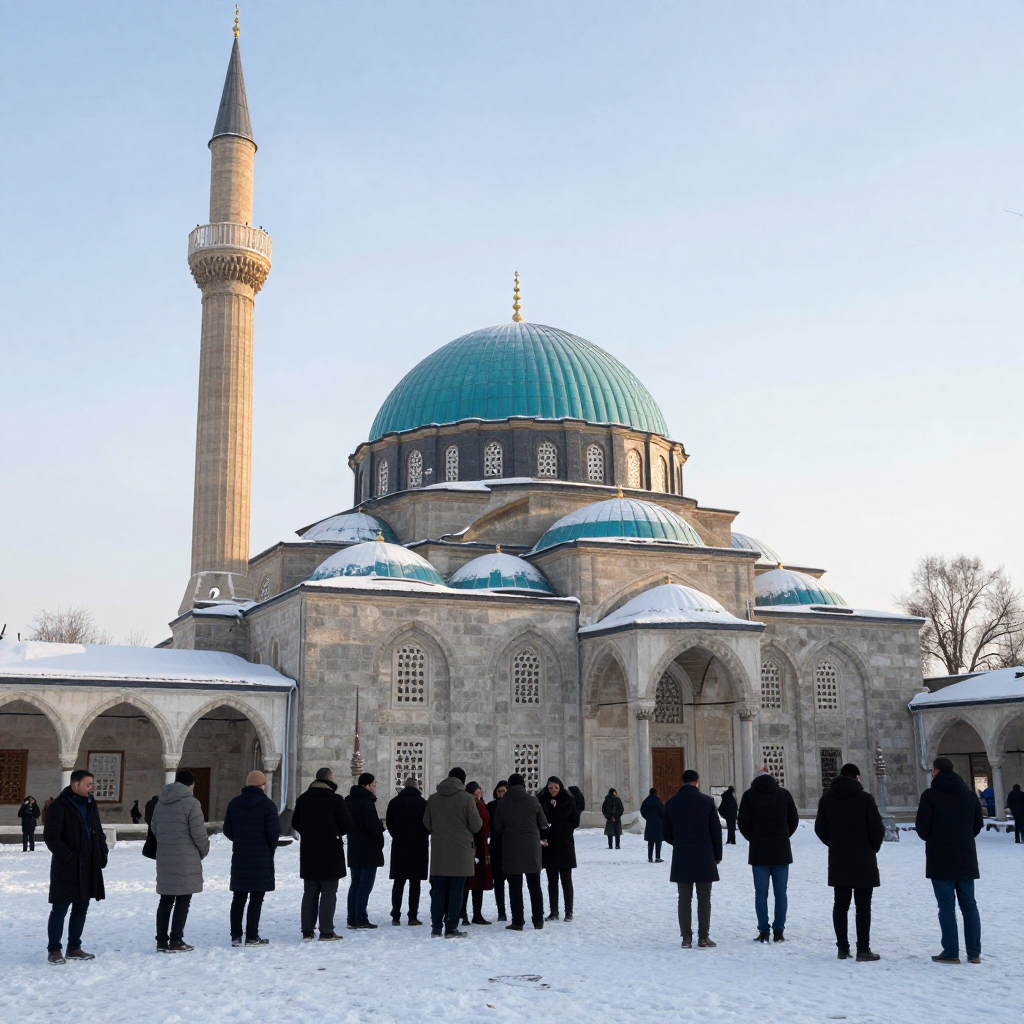
Every December, the turquoise-tiled dome of the Mevlana Museum in Konya raises the same question for first-time visitors: how can the anniversary of a death be called a wedding night? Şeb-i Arûs is the answer. Here we explain the week of commemoration in Konya, the sema ceremony and why the tradition is still alive. If you want to find cultural events near you, takvim.in lets you search commemorations and sema programmes by city.
Key points
- Şeb-i Arûs means "nuptial night" or "night of union"; it marks the death of Mevlânâ Jalaluddin Rumi on 17 December 1273.
- In Konya the commemoration week traditionally runs from 7 to 17 December and ends on the night of the 17th.
- UNESCO proclaimed the Mevlevi sema ceremony in 2005 and inscribed it on the Representative List of the Intangible Cultural Heritage of Humanity in 2008.
- The sema has four parts, and every piece of the costume carries symbolic meaning.
What does Şeb-i Arûs mean?
"Şeb" means night and "arûs" means bride or wedding; together they give "wedding night" or "night of union". Rumi died in Konya on 17 December 1273, aged 66. The date is called a night of union rather than a night of mourning: death is remembered as a meeting, not an ending.
Over time the phrase came to describe not one night but a whole week of events. UNESCO's records list a "Şeb-i Arûs Week" in Konya, for 2020 from 7 to 17 December. The main night is 17 December; the days before it bring sema performances and commemorative events. Details are announced by official bodies each year, so check the current announcement for tickets and times.
Who was Rumi?
Rumi was born on 30 September 1207 in Wakhsh, in present-day Tajikistan, on the east bank of the Wakhsh River. A turning point in his thinking was meeting Shams of Tabriz on 15 November 1244, a friendship that changed how he approached poetry and music.
His masterpiece, the Masnavi, is written in Persian in six books of roughly 4,000 couplets each, about 25,000 in all. Rumi began dictating the first book around 1258, at about 54, and continued until his death; the sixth book was never finished. The person who asked for the work and wrote down the verses as they were spoken was his favourite disciple, Husam al-Din Chalabi.
The tomb and the museum
Rumi's mausoleum was completed in 1274 under the architect Badr al-Din Tabrizi, with funding from Gurju Khatun and Emir Alameddin Kayser. Rumi lies there beside his father Baha' ud-Din Walad and his son Sultan Veled. The Seljuk sultan Alaeddin Kayqubad is said to have given his rose garden as the burial place for Rumi's father.
A decree of 1926 turned the mausoleum and lodge into a museum, which opened on 2 March 1927 and took the name Mevlana Museum in 1954. About 3.4 million people visited in 2019, making it Turkey's most-visited museum that year. The complex has an 88-metre minaret and 17 dervish cells built under Murad III. Anyone in Konya during Şeb-i Arûs is therefore walking through a complex more than seven centuries old, not just attending a ceremony.
How does the sema ceremony work?
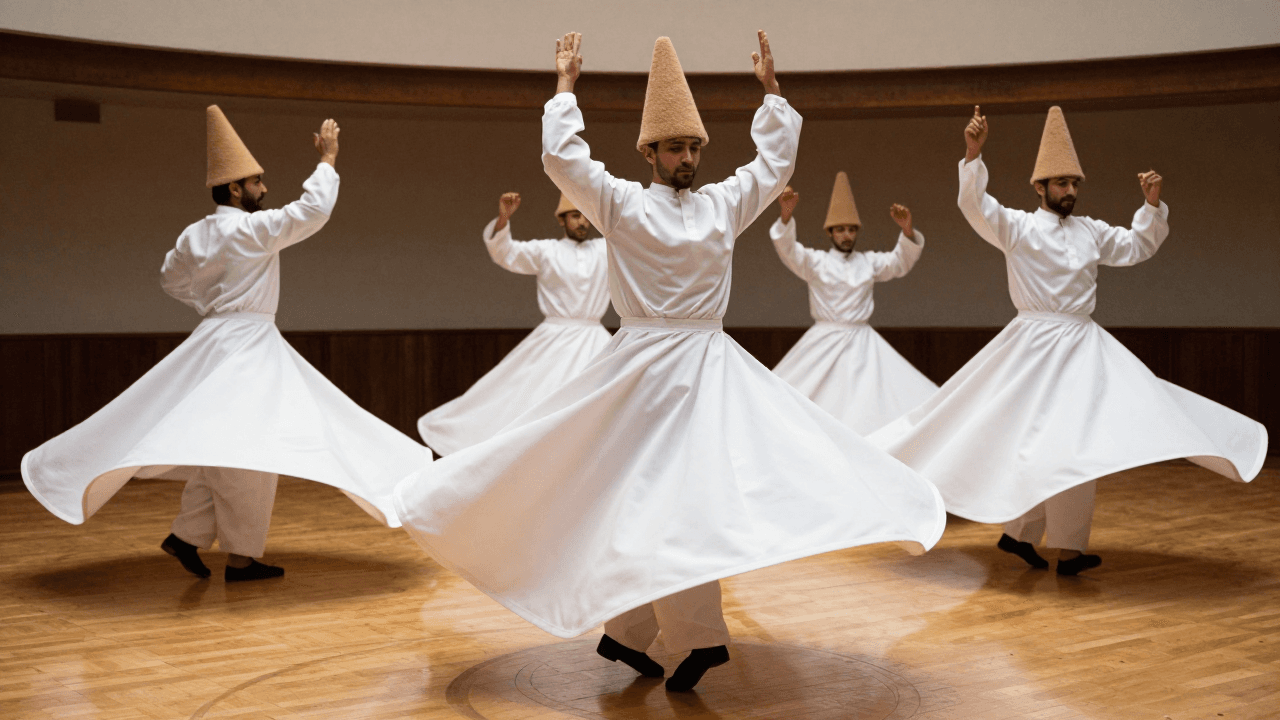
The sema is the whirling part of the Mevlevi ritual. The semazens (whirling dervishes) fast for several hours beforehand, turn on their left foot and use the right foot to drive the body round. The accompanying music is called the ayin and has four sections; performing it takes at least one singer, a neyzen (ney player), a kettledrummer and a cymbal player.
The ceremony unfolds in four stages:
- Naat-i Sharif: a solo eulogy to the Prophet, closed by a ney improvisation.
- Devr-i Veled: the semazens walk in single file around the hall three times, then remove their black cloaks.
- The four salams: the core of the ceremony, made up of four musical movements.
- Quranic recitation: the ceremony usually ends with verse 115 of the second surah, al-Baqara.
What do the costumes mean?
The black cloak stands for death and the grave, the tall brown hat (sikke) for the tombstone and the death of the ego. The white robe (tennure) and white jacket (destegül) stand for resurrection. The semazen enters carrying death and, on taking off the cloak, enacts rebirth. At Şeb-i Arûs the sema is less a show than a story of death and union.
How long was the training?
According to UNESCO, semazens once trained for 1,001 days in lodges (mevlevihane), learning ethics, rules of conduct and belief through prayer, devotional music, poetry and dance. Afterwards they stayed members of the order but went back to their work and families.
The ney: the sound of the sema
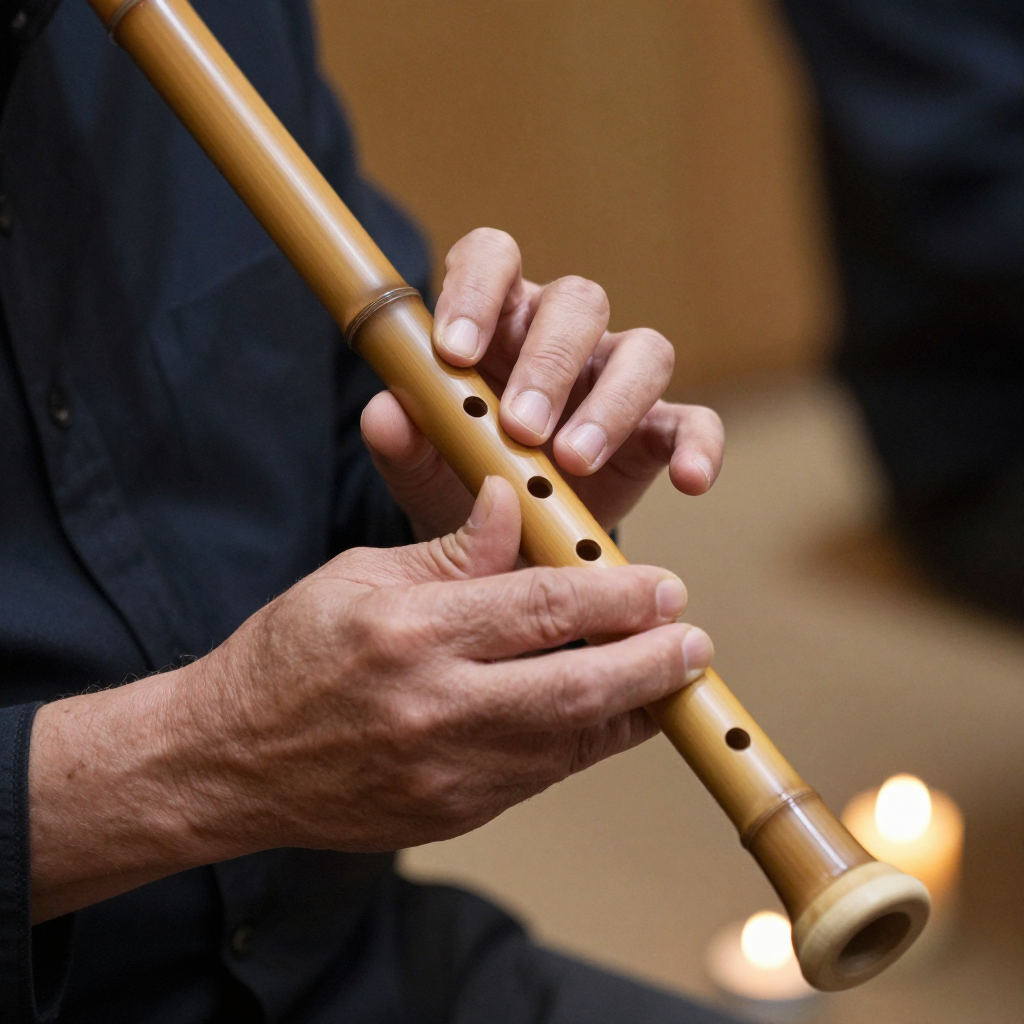
The instrument that sets the mood is the ney, made from a hollow cane (Arundo donax) and, by most accounts, played for more than 4,500 years. Turkish and Arabic neys usually have seven holes: six in front and a thumb hole at the back. A skilled neyzen can reach more than three octaves. In the ayin a single sustained breath carries the ceremony while the semazens turn, and when the ney falls silent the silence says more than words.
From Istanbul: the Galata Mevlevi Lodge
Visitors who cannot get to Konya for Şeb-i Arûs have an option in Istanbul. According to most sources the Galata Mevlevi Lodge was founded in 1491, was the city's first Mevlevi lodge, and was closed on 25 October 1925 by the law banning the orders. It can be visited today as a museum; sema performances and opening hours vary by season, so confirm current details on the Istanbul Culture and Arts Museum page or in official announcements.
What should first-timers watch for?
At first glance the sema looks like uniform spinning, but anyone who knows the four stages can read it as a story. Watch the black cloaks as the dancers enter, the three circuits and the moment the cloaks come off: that is where the narrative moves from death to resurrection. Then follow how the music changes direction in each of the four salams. Don't miss the verse recited at the end; the turning stops and words begin again. Leaving your phone in your pocket is the easiest way not to break the flow.
Ban, silence and a return to the public eye
Mevlevi history is not a straight line. In 1925 all the lodges were closed under secularising measures. Public sema performances returned in the 1950s and restrictions eased in the 1990s. UNESCO notes that many performances are now shortened and simplified for tourist audiences, while some private groups try to restore the ceremony's spiritual character.
That distinction matters for the audience: the sema can be watched as a performing art, but it grew out of a devotional tradition. Applause, flash photography and chatter are out of place; the weight of the ritual deserves respect.
Before you go to Konya
- Confirm the dates. The commemoration week is traditionally 7-17 December; check the annual programme from official sources.
- Think about tickets early. Interest peaks around 17 December. Prices and sales dates change each year, so we quote no figures.
- Plan for the cold. Be ready for winter weather in Konya.
- Give the museum its own day. Visiting the tomb and exhibits is a different experience from watching a sema and should not be rushed.
Frequently asked questions
Is Şeb-i Arûs on the same day every year?
The anniversary is observed on 17 December in the Gregorian calendar. The weekly programme in Konya is traditionally held between 7 and 17 December; details are announced each year by official bodies.
Is the sema a dance or an act of worship?
It has traces of both. In the Mevlevi tradition the sema is a form of contemplation and remembrance. Many of today's performances are presented as cultural events, and that difference shapes how an audience relates to the ceremony.
When did UNESCO recognise the sema?
The Mevlevi Sema Ceremony was first proclaimed in 2005 among the Masterpieces of the Oral and Intangible Heritage of Humanity, then inscribed on the Representative List of the Intangible Cultural Heritage of Humanity in 2008.
When was the Year of Rumi?
UNESCO declared 2007 the International Rumi Year, marking the 800th anniversary of his birth.
A death that carries a wedding's name
The shortest way to grasp Şeb-i Arûs is to see it as a way of looking rather than a date. Remembered since 1273, this night invites us to treat disappearance as a passage, not an end. Whether or not you travel to Konya, watching a sema in December or reading a few couplets of the Masnavi is a quiet way to approach the tradition.