At noon on a Saturday in mid-September, a mayor in a Bavarian tent swings a wooden mallet at a barrel and shouts "O'zapft is!", which means "it's tapped." Within minutes, tens of thousands of people in leather breeches and pinafore dresses start raising one-litre glasses. That is the opening of Oktoberfest in Munich, the largest folk festival in the world in terms of visitors, and one that has been misunderstood as "just a beer party" for decades. On takvim.in we follow recurring occasions like this one, so here is the full story: where Oktoberfest comes from, what really happens on the grounds, and how to experience it without getting lost in the crowd.
Key takeaways
- Oktoberfest began in 1810 as a public party for the wedding of Bavaria's Crown Prince Ludwig and Princess Therese, not as a beer event.
- Despite the name, it is held mostly in September: usually 16 days, from the first Saturday after 15 September to the first Sunday in October.
- Only beer from Munich's six big breweries, brewed within the city limits under the Reinheitsgebot purity law, is served, always by the one-litre Maß.
- The festival draws roughly six to seven million visits a year (7.2 million in 2023, about 6.5 million in 2025), and entry to the grounds is free.
- Beer tents, rides, a costume parade, brass music and Bavarian food together make the Wiesn, as locals call it, a fairground first and a drinking session second.
- Hundreds of "Oktoberfests" elsewhere borrow the name, but the original is a specific place: the Theresienwiese in Munich.
Where does Oktoberfest come from?
The story starts on 12 October 1810, when Crown Prince Ludwig of Bavaria, later King Ludwig I, married Princess Therese of Saxe-Hildburghausen. The citizens of Munich were invited to celebrate with the royal couple on the meadows outside the city gates. The celebrations closed on 17 October with a horse race, which reportedly drew more than 40,000 spectators, a huge crowd for a city of that time.
The field was named Theresienwiese, "Therese's meadow", in honour of the bride. Munich people shortened it to "die Wiesn" (the meadow), and that is still what they call both the site and the festival. The horse race was repeated the following year, and in 1811 an agricultural show was added to promote Bavarian farming. Over the decades came skittles, swings, stalls, and eventually beer.
Not every year happened. The festival was cancelled during the wars of 1914 to 1918 and 1939 to 1945, during the cholera outbreaks of 1854 and 1873, in the hyperinflation years of 1923 and 1924, and in 2020 and 2021 because of the pandemic. That is why the 2026 edition is counted as only the 191st, even though the first party took place more than two centuries ago.
When is Oktoberfest, and why is it mostly in September?
The name says October, the calendar says September. In the early years the party ran in October, but Munich moved it forward because September evenings are warmer and the weather is more reliable for a festival held largely outdoors. Since 1994 the rule has been simple: it starts on the first Saturday after 15 September and ends on the first Sunday of October, which gives 16 days. When that would end before 3 October, German Unity Day, it is stretched by a day or two to reach the holiday.
| Year | Dates | Note |
|---|---|---|
| 2023 | 16 September to 3 October | About 7.2 million visitors, a record |
| 2025 | 20 September to 5 October | About 6.5 million visitors and 6.5 million Maß served |
| 2026 | 19 September to 4 October | The 191st Oktoberfest, opened by Mayor Dominik Krause |
The exact dates shift every year, so check the official calendar before booking travel; takvim.in also lists festival seasons worth planning around. The festival is held on the Theresienwiese, a large open ground just southwest of Munich's centre, with a subway station named after it (Theresienwiese, on the U4 and U5 lines).
What actually happens on opening day?
Opening day has a fixed choreography that has been repeated since 1950, when the mayor of Munich tapped the first keg for the first time. It begins with a parade of festival hosts and brewery horse-drawn wagons through the city towards the grounds. Around noon, in the Schottenhamel tent, the mayor hammers a tap into the first barrel. The aim is to do it in as few strokes as possible. As the words "O'zapft is!" ring out, twelve gun salutes are fired in front of the Bavaria statue, and only then may the other tents begin serving. The first ceremonial Maß goes to the Minister-President of Bavaria.
The ceremony is shown live on Bavarian television, and it is worth understanding that beer service before that shot is not allowed. If you arrive at 11 in the morning wanting a drink, you will wait.
What do people drink and eat at the Wiesn?
Beer is the centre of it, and it is regulated tightly. Only the six Munich breweries, Augustiner, Hacker-Pschorr, Hofbräu, Löwenbräu, Paulaner and Spaten, may serve at Oktoberfest. Their beer must be brewed inside Munich and follow the Reinheitsgebot, the 1516 Bavarian purity law that allows only water, malt and hops (yeast was added to the list once it was understood). The festival beer is somewhat stronger than everyday lager, usually a little above 6 percent.
It is served in a Maß, a heavy glass mug holding one litre. In 2025 a Maß in the large tents cost between 14.90 and 15.90 euros. Visitors drank about 7.4 million litres in 2023 and about 6.5 million Maß in 2025. Those numbers explain why the festival's tents and staff are among the most tightly organised in Europe.
Food is not an afterthought. Typical dishes include roast half chicken (Hendl), pork knuckle (Schweinshaxn), giant pretzels, sausages, radish cut in spirals, and sweet things such as candied almonds and gingerbread hearts. Vegetarian plates exist but are still the minority.
What are the tents, and how do they differ?
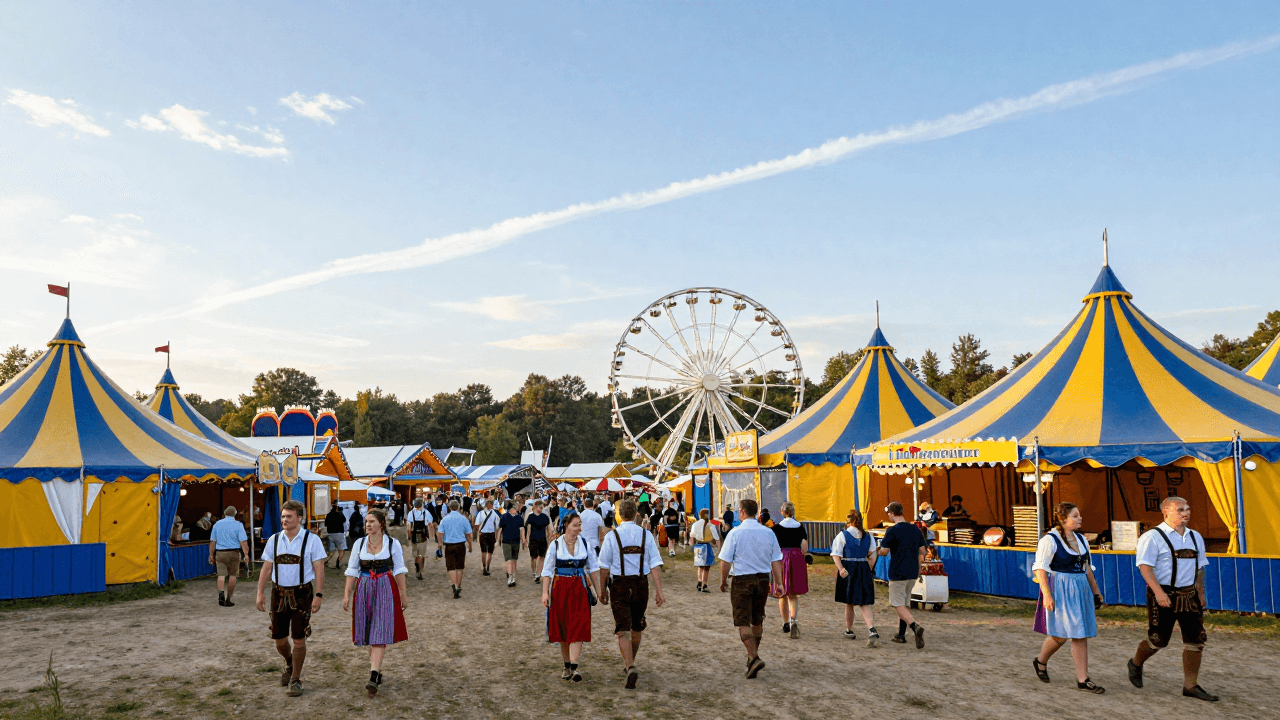
The tents are the heart of the grounds. In 2025 there were 14 large tents and 20 small ones. The largest, the Winzerer Fähndl, seats about 8,450 people inside. Each tent is run by a Wiesnwirt, a host who is often from a family that has done this for generations, and each has its own character: some are known for brass bands and a traditional mood, others for evening singalongs on the benches, and one is dedicated to wine.
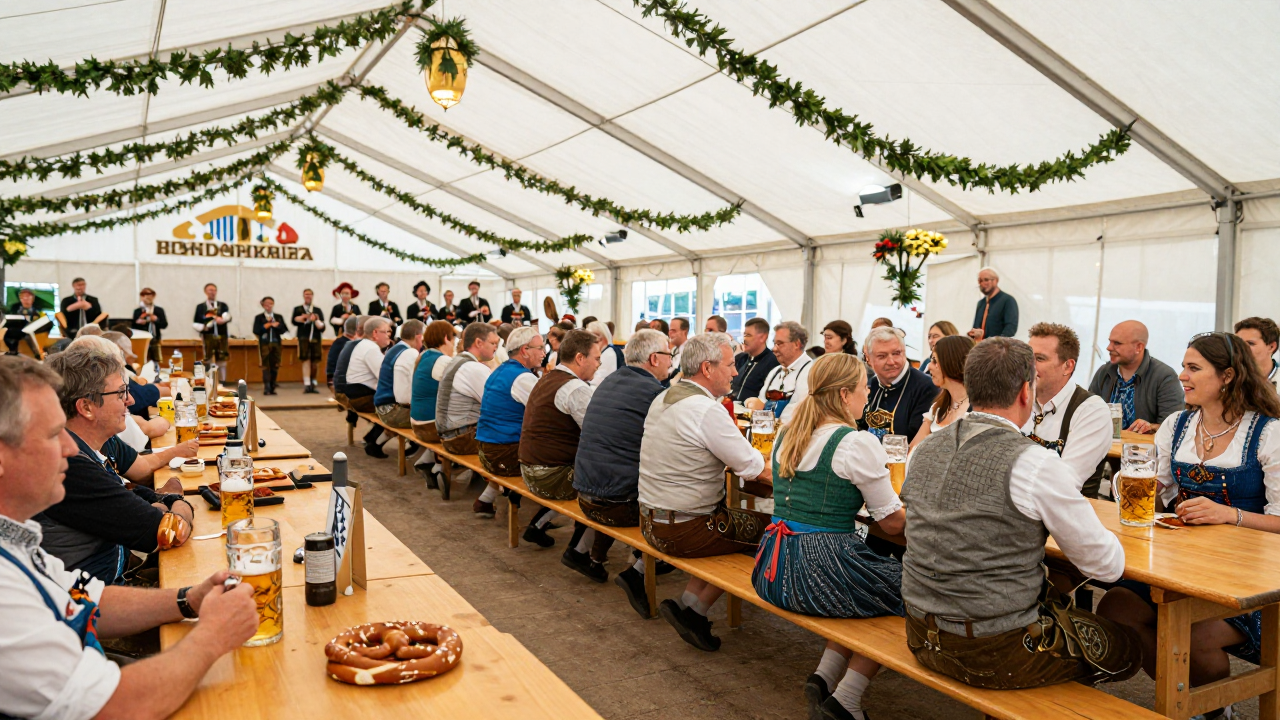
The music follows a pattern. In the daytime it is Bavarian brass, and later the bands add pop and party songs. Standing on the benches to sing is normal in the evening, but not before, and staff will ask you to sit if the tent is quiet.
One important point for planning: entry to the grounds is free, but seats inside the tents are reserved by tables, often months ahead. Walk-ins are possible, especially on weekday mornings and early afternoons, when you can hope for a free seat. Evenings and weekends are far busier, and in 2025 the grounds were closed because of overcrowding on two days.
Why do people wear Lederhosen and Dirndl?
Traditional dress, called Tracht, is not compulsory, but most locals wear it and a large share of visitors follows. Men wear Lederhosen, leather breeches, and women wear a Dirndl, a dress with a bodice and apron. The bow on the apron has a popular code: tied on the right means taken, on the left means single, and at the back centre traditionally signals a widow. Treat it as a folk custom rather than a rule; staff often tie theirs at the back for practical reasons.
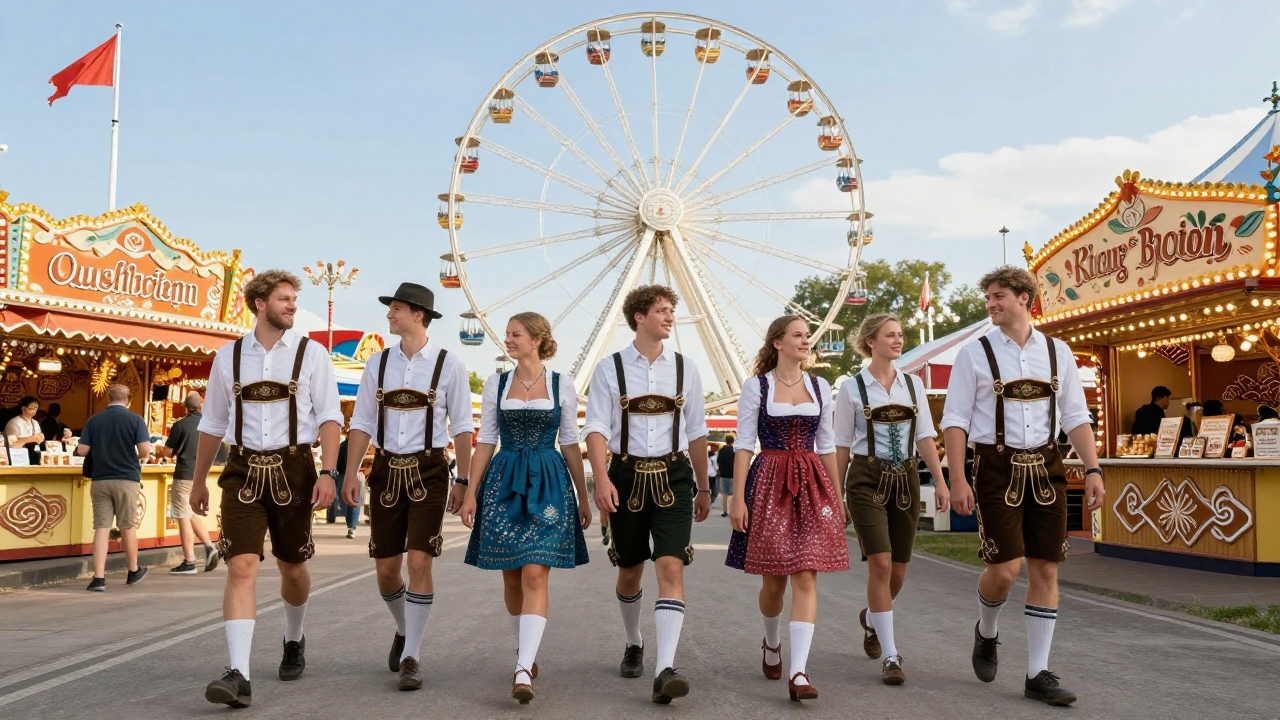
Munich locals tend to invest in a good, durable Tracht instead of a cheap costume. If you buy one, expect to pay for quality, or rent one.
There is a public display of all this: since 1850 the Trachten- und Schützenzug, a parade of costumes and marksmen, has marched through central Munich on the first Sunday, with roughly 8,000 participants along a 7 km route to the grounds.
What is there besides beer?
Quite a lot, and this is what separates the Wiesn from a beer hall. The grounds hold rollercoasters, a Ferris wheel, a big flying carousel, traditional shooting galleries, and stalls. Families with children come in the daytime, and there are special family days with lower prices on the rides.
The same logic applies when you browse seasonal festivals on takvim.in: learn what the occasion is before you decide how to go. There is also the Oide Wiesn ("Old Wiesn"), a separate area that looks and sounds like an older festival, with historic rides, folk music and horse-drawn carousels. It costs a small admission (four euros in 2025, free after 9 pm), and is a good option if the main grounds feel too loud.
How can you experience Oktoberfest well?
- Go early. On weekdays, arrive at opening time for a seat without a reservation. Weekends and evenings are crowded.
- Book ahead if you want a table. Reservations are made directly with tents and normally open months before.
- Watch the pace. Festival beer is stronger than it looks, and eating well between rounds is part of the local approach.
- Try the Oide Wiesn or the parade if you want the cultural side more than the party.
- Use the subway. Munich's public transport is the standard way in; driving is not practical.
About 21 percent of visitors on average in 2025 came from abroad, and around 30 percent on the middle Saturday, so you will not be alone as a foreigner.
Are there Oktoberfests outside Munich?
Yes, many. Kitchener-Waterloo in Canada runs one that draws around 700,000 people a year, and cities around the world hold events with the name. They usually share the brass music and the beer, but not the site, the six breweries or the two-century history. If you are searching for one nearby, look at the organiser's own description rather than the label alone.
FAQ
Is Oktoberfest really in October?
Mostly not. It usually starts in the second half of September and ends on the first Sunday in October, about 16 days in total.
Does it cost money to get in?
No, entry to the Theresienwiese is free. You pay for drinks, food and rides, and for the Oide Wiesn, which had a small admission fee in 2025.
Do I have to wear Lederhosen or a Dirndl?
No. Many visitors do not, but Tracht is common, and it adds to the atmosphere. Buy quality if you buy at all.
Is Oktoberfest suitable for children?
By day, yes. There are rides, family days and quieter areas, though tents get loud and crowded in the evening.
Conclusion
Oktoberfest is a royal wedding turned into a public habit, and more than two centuries later it is still organised around the same meadow. The beer is the headline, but the rides, the parade, the brass bands and the costumes are what make it a festival and not just a drinking session. To find festivals, parades and seasonal events close to you, whether in Munich or at home, browse takvim.in.