
Every August, a small inland town in eastern Spain turns its main streets into a river of crushed tomatoes for exactly one hour. Around 20,000 people, most of them strangers to each other, throw fruit at one another until the whole place is red. Then a cannon fires, everyone stops, and the fire brigade starts hosing down the walls. It is called La Tomatina, and on takvim.in it belongs to the group of occasions that are worth planning a trip around, because the rules, the tickets and the timing are far more organised than the mess suggests.
Key takeaways
- La Tomatina is held in Buñol, a town of roughly 9,000 people about 40 km from Valencia, on the last Wednesday of August.
- The tomato fight itself lasts about one hour and is framed by two cannon shots, one to start it and one to end it.
- Since 2013 entry has been ticketed, with participation capped at about 20,000 people.
- The story usually told is that it began in 1945 with a scuffle at a vegetable stall; it was later banned under Franco and legalised again after a 1957 protest.
- The tomatoes are overripe, low-grade fruit brought in by truck, roughly 120,000 to 150,000 kg depending on the year and the source.
- Protective basics matter more than costume: goggles, closed shoes and clothes you are happy to lose.
Where does La Tomatina come from?
Nobody can point to a single documented founding moment, but the most repeated account places the first tomato fight in 1945 in Buñol's main square. During a parade of giants and big-headed figures (a standard feature of Spanish town fiestas), some young people started a scuffle, and the fight spilled into a nearby vegetable stall. Tomatoes were within reach, so they became ammunition. According to the same account, the following year a group of young people repeated the fight on purpose, this time bringing their own tomatoes from home, and a habit was born.
Other versions circulate as well: a protest against an unpopular local official, or an old game among local teenagers. These are folk explanations rather than settled history, and it is fair to say the exact origin is unknown. What the accounts agree on is that it started as an informal, slightly unruly street prank and grew because people kept doing it.
The authorities were not always amused. In the early 1950s, during the Franco dictatorship, the fight was banned, partly because it had no religious character and did not fit the official idea of a proper fiesta. Locals kept trying to bring it back. The best-known episode is a 1957 protest in which residents staged a "tomato funeral", carrying a coffin with a large tomato in it through the streets. The stunt worked, and the fight was officially permitted again. From there it grew into a fixture, and in 2002 it was declared a Fiesta of International Tourist Interest in Spain.
When and where is it held?
La Tomatina takes place on the last Wednesday of August, so the date moves from year to year. In 2026, for example, it fell on 26 August. Buñol is in the province of Valencia, about 40 km inland from the city of Valencia, and the fight happens in the streets of the old centre rather than in a stadium or field.
The tomato battle belongs to a longer fiesta. It falls within the celebrations of San Luis Beltrán, the town's patron saint, which fill the surrounding days with parades, music, fireworks and food. The tomato fight is the most famous part, but it is one item in a town festival that existed in a different form before tourists arrived.
On the day itself the fight is normally scheduled around midday, roughly between noon and 1 pm. Participants have to arrive earlier for access checks and to exchange their ticket for an official wristband, which the organisers hand out in town from about 7 am.
What actually happens on the day?
The morning starts with the palo jabón, Spanish for "soaped pole". A ham is tied to the top of a greased wooden pole, and participants try to climb it and knock the ham down. Until someone manages it, the tomato trucks are supposed to wait, and this can take a long time because the pole is very slippery. Once the ham is down, or the organisers decide the moment has come, a cannon shot signals the start.
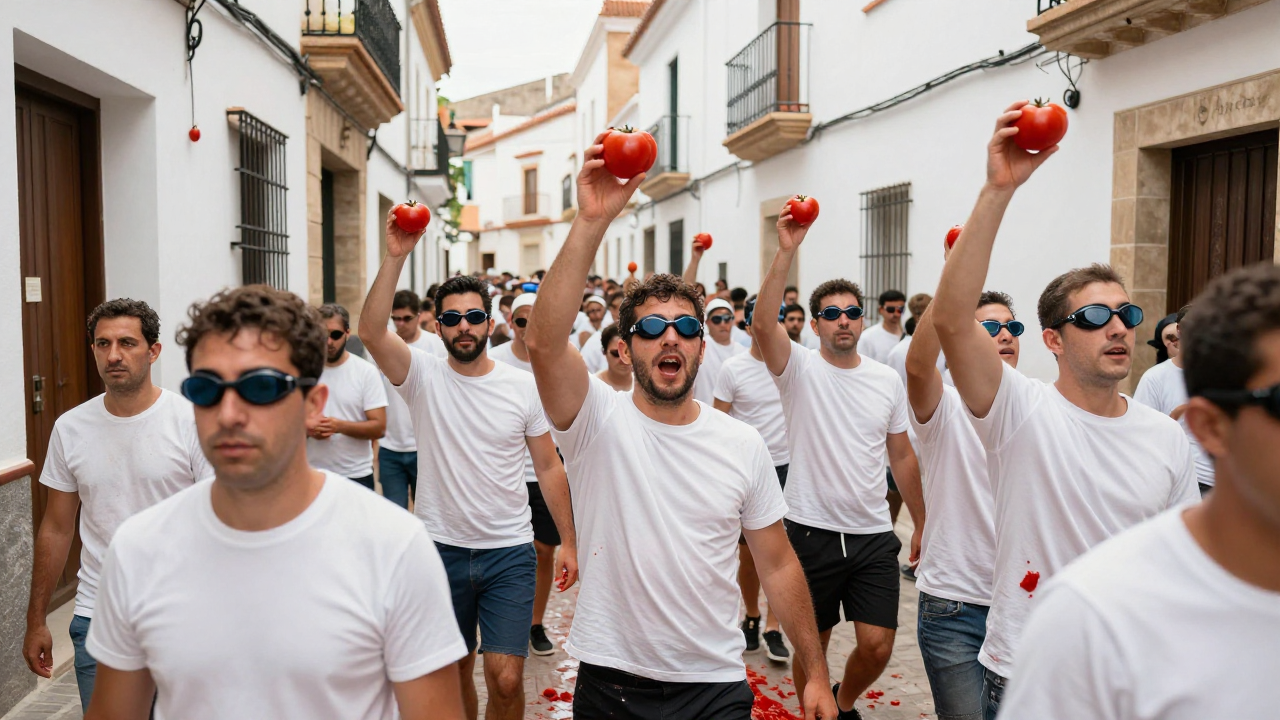
Then the trucks roll into the narrow streets and the tomatoes are dumped. Everyone is a target and everyone is a thrower. Crowds are packed tightly, so the fight is less a duel than a red tide: people wade through pulp, throw from a few metres away, and get thrown at from the balconies. After roughly an hour, a second cannon shot ends the fight, and the official rule is that throwing must stop immediately.
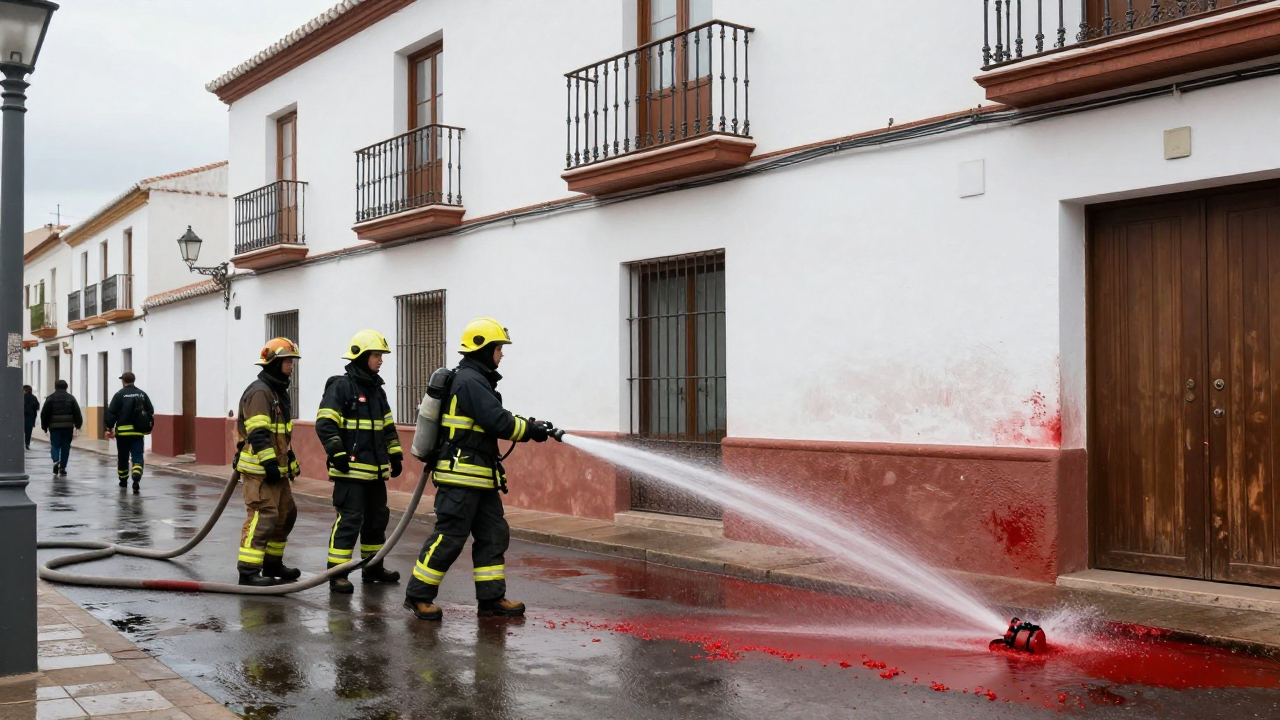
Cleanup is impressively fast. Municipal crews and fire trucks hose down the streets and building fronts, and residents who spent the morning behind plastic sheeting take it down. Many participants are also hosed off, or head to a nearby river or improvised showers to rinse off. The town's short list of official rules is worth memorising before you go:
- Squash each tomato in your hand before you throw it, so that it is soft and cannot hurt anyone.
- Throw only tomatoes. Nothing hard, no bottles, no other objects.
- Keep a safe distance from the trucks and follow staff instructions.
- Stop throwing the moment the second cannon shot sounds.
- Do not tear other people's clothes.
Why did it need tickets, and how big is it now?
For decades La Tomatina was free and open, and the crowds grew until they were several times larger than Buñol itself. Since 2013 the town has run it as a ticketed event with a cap of about 20,000 participants, a number chosen to protect a town of around 9,000 residents and to make the fight safer. Tickets are exchanged for a wristband on the day, and bags and bottles are generally not allowed through the security checks; lockers are available for your belongings.
The pandemic interrupted the tradition: the 2020 and 2021 editions were cancelled. It returned in 2022, and the 2025 edition marked the 80th anniversary of the first fight and reportedly drew more than 22,000 participants. Here is a quick comparison of the main facts and figures:
| Aspect | Detail |
|---|---|
| Town | Buñol, province of Valencia, about 40 km from Valencia city |
| Date | Last Wednesday of August |
| Duration of the fight | About one hour, between two cannon shots |
| Participants | About 20,000, with tickets since 2013 |
| Tomatoes | Roughly 120,000 to 150,000 kg, overripe and low-grade |
| Recognition | Fiesta of International Tourist Interest (2002) |
| Cancelled | 2020 and 2021 |
What makes it different from other food fights?
There are other tomato and food-throwing events around the world, and some borrow the name, but La Tomatina has a few things that give it a distinct personality. First, it is short: a one-hour fight with a clear start and end is a very different experience from an all-day party. Second, it is tied to a real town with a real fiesta calendar and a patron saint, rather than being staged for visitors from scratch. Third, it is genuinely regulated. The tomatoes come from growers who supply low-grade fruit unfit for sale, not food taken from tables, and the ticket cap, the two-shot structure and the cleanup routine are all part of what makes a chaotic event survivable.
There is also the atmosphere. Because the town is small, the streets funnel the crowd tightly, and the sensory experience is unusual: the smell of tomato, the slippery ground, the sound of thousands of people laughing at once. For many visitors, the bonding with strangers is the actual point.
How do you experience it well?
The practical advice is not glamorous but it is the difference between a good day and a bad one.
- Protect your eyes. Tomato acid stings, so goggles are the single most useful item. Swimming goggles work fine.
- Wear closed shoes you do not love. Flip-flops are lost within seconds, and the streets are slippery.
- Dress to throw away. A white T-shirt turns red immediately. Old clothes and shorts that can be binned are ideal.
- Waterproof your phone or leave it behind. Lockers are available in town, and a waterproof pouch is a good idea if you insist on bringing a camera.
- Buy the official ticket only. Entry to the fight requires an official ticket, and the town posts the details on its official pages. Check the current price and terms there, because they change by year.
- Plan the return trip. Buñol is reachable from Valencia by train and by organised buses, and many visitors stay in Valencia and go for the day. Book transport early, because August is a busy month.
- Stay for the town. After the cleanup, the streets fill up again with people, food and music, and it is a chance to see Buñol as a town rather than a battlefield.
FAQ
Is La Tomatina dangerous?
The main risks are slipping, eye irritation and being jostled in a dense crowd. The rules exist to reduce those: squash the tomatoes, throw only tomatoes and stop at the second cannon shot. Goggles and closed shoes handle most of the rest.
Do I need a ticket?
Yes. Since 2013 the fight has been ticketed with a cap of about 20,000 participants, and the ticket is exchanged for an official wristband on the day. Prices and package options vary by year, so check the official Buñol ticketing pages.
Can children take part?
There is a separate children's version for ages roughly 4 to 14, described as a shorter and safer mini tomato fight lasting around 30 to 40 minutes. Check the current organiser details for the exact age and format.
How long does it last, and what happens afterwards?
The fight lasts about an hour. Afterwards, crews and fire trucks wash down the streets, and participants rinse off. The town becomes a normal, if slightly pink, place again within hours.
Where to find more like it
La Tomatina is one of many recurring occasions where a local tradition turns into a global draw. If you are planning your year around festivals, carnivals and seasonal celebrations, takvim.in is a good place to look for what is happening near you and for the next event you might want to build a trip around.