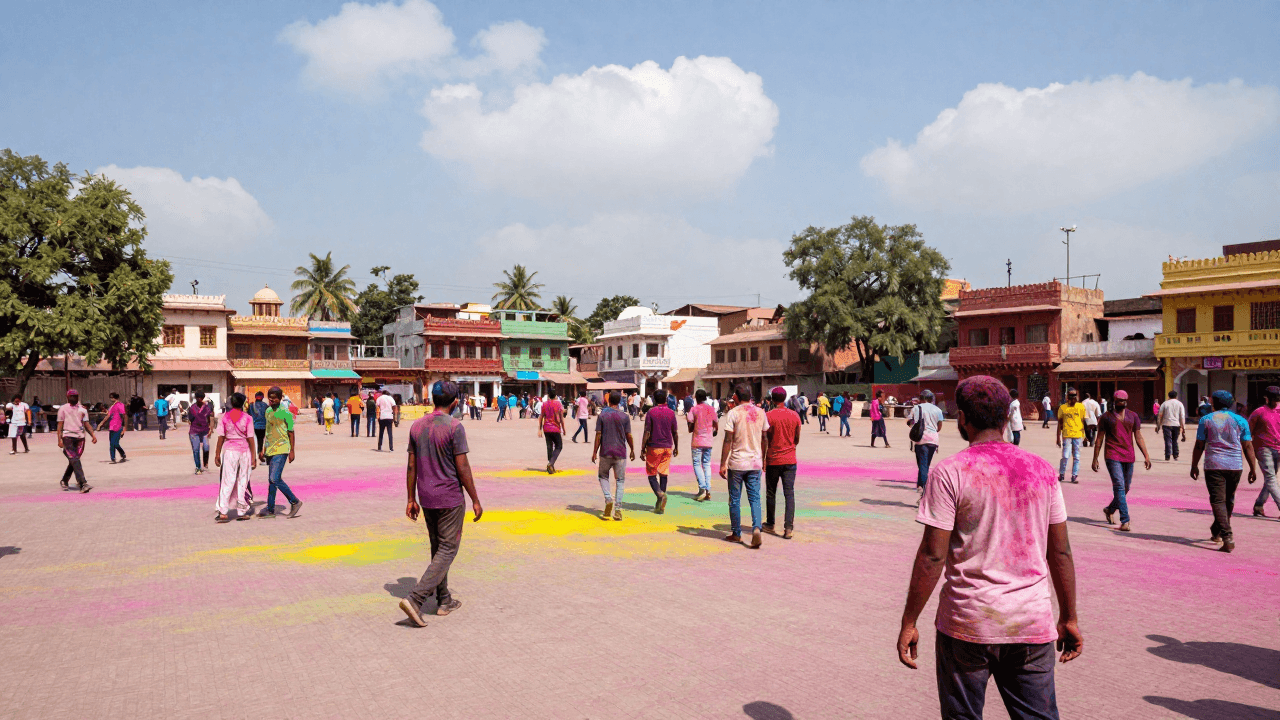
Picture a street where, for a few hours, nobody's clothes are white any more: strangers, neighbours and grandparents are covered in pink, yellow and green powder, water arcs from brass syringes, and somebody has pressed a sweet dumpling into your hand. That is Holi, the Hindu spring festival known as the festival of colours, and it has been doing this for well over a thousand years. Here is what it actually celebrates, where it comes from, and how people around the world join in, whether or not they grew up with it. If you like to plan around occasions like this, takvim.in keeps track of festivals worldwide.
Key takeaways
- Holi is a Hindu spring festival held on the full moon of the lunar month of Phalguna, usually in March and sometimes in late February. The date changes every year.
- It has two parts: Holika Dahan, a bonfire on the evening of the full moon, and Rangwali Holi (or Dhulandi), the day of coloured powder and water the next morning.
- The central story is the victory of good over evil, told through Prahlad and Holika. A second, playful story about Krishna and Radha explains the colours.
- Holi is more than one day everywhere: in the Braj region around Mathura the season stretches to about 40 days, and in Kathmandu a ceremonial pole goes up a week before the full moon.
- Outside India, it lives on in Nepal, in Caribbean and other diaspora communities, and in newer colour festivals such as the one in Spanish Fork, Utah, and Istanbul's Holifest, first held in 2016.
- Protect your eyes, skin and lungs: many cheap powders are synthetic, and natural or herbal colours are the safer choice.
What is Holi, and why colours?
Holi is a Hindu festival that welcomes spring and marks the end of winter. It is celebrated mainly in India and Nepal, and by Hindu communities elsewhere. The word is tied to the demoness Holika, whose story is below, and the festival is also called the festival of colours, the festival of spring and, in some places, the festival of love.
The colours have a job. Coloured powder is called gulal (or abir), and in the traditional telling each shade carries a meaning: red for love and fertility, yellow for prosperity and new beginnings, green for spring and new life, blue for Krishna. Underneath the symbolism is something simpler and more social. On Holi, ordinary rules about age, status and formality relax for a day. People visit friends, forgive old quarrels, and are expected to accept being drenched in good humour. A common phrase you will hear is "Bura na mano, Holi hai", roughly "don't take offence, it's Holi".
Where does Holi come from?
There are several origin stories, and they layer rather than compete.
Prahlad and Holika. The best-known legend features Hiranyakashipu, a king who considered himself equal to a god and demanded that everyone worship him. His son Prahlad refused and stayed devoted to the god Vishnu. Hiranyakashipu tried repeatedly to kill the boy. In the final attempt, his sister Holika, who had a boon that protected her from fire, sat in a blazing pyre with Prahlad on her lap. The boon failed her, Holika burned, and Prahlad walked out unharmed. This is why Holi begins with a bonfire, and why the evening is called Holika Dahan, "the burning of Holika".
Krishna and Radha. The second story is the source of the colours. Krishna, the blue-skinned god who grew up in the Braj region, worried that fair-skinned Radha would not love him because of his complexion. His mother, the tale goes, suggested he smear colour on Radha's face, and so he did. This is why Holi is celebrated with the most exuberance in Mathura, Vrindavan, Barsana and Nandgaon, the towns linked to Krishna and Radha.
The historical record. The festival is far older than the modern colour-throwing craze. Early Sanskrit texts and the Puranas describe spring festivities of this kind, and the seventh-century play Ratnavali, attributed to King Harsha, describes a festival called holikotsava. Relief carvings at Hampi in Karnataka, the capital of the Vijayanagara empire, show women playing with water squirts and are dated between the 14th and 16th centuries. So people have been throwing water and colour at one another in spring for well over a millennium.
Because it sits on the full moon that also marks the turn of the season, Holi is also an agricultural festival, timed to the wheat harvest in the north, which explains why grains are among the offerings thrown into the fire.
When is Holi, and how long does it last?
Holi follows the Hindu lunar calendar, so the Gregorian date shifts. It falls on Phalguna Purnima, the full moon of the month of Phalguna, usually in March and occasionally in late February. It lasts a night and a day: the bonfire on the evening of the full moon, and the colours the following day.
| Year | Holika Dahan (bonfire) | Rangwali Holi (colours) |
|---|---|---|
| 2025 | 13 March | 14 March |
| 2026 | 3 March (evening) | 4 March |
| 2027 | 21 March | 22 March |
Dates can differ by a day between regions and almanacs, because they depend on where the full moon rises and which local rules are used. Always check a regional source for the year you plan to attend.
In some places the festival is much longer than these two days. In the Braj region of Uttar Pradesh, which includes Mathura, Vrindavan, Barsana and Nandgaon, the celebrations begin around Vasant Panchami and run for roughly 40 days. In Telangana it is marked over ten days, and in Kanpur in Uttar Pradesh it lasts seven days and closes with a fair called the Ganga Mela.
What actually happens on Holi?
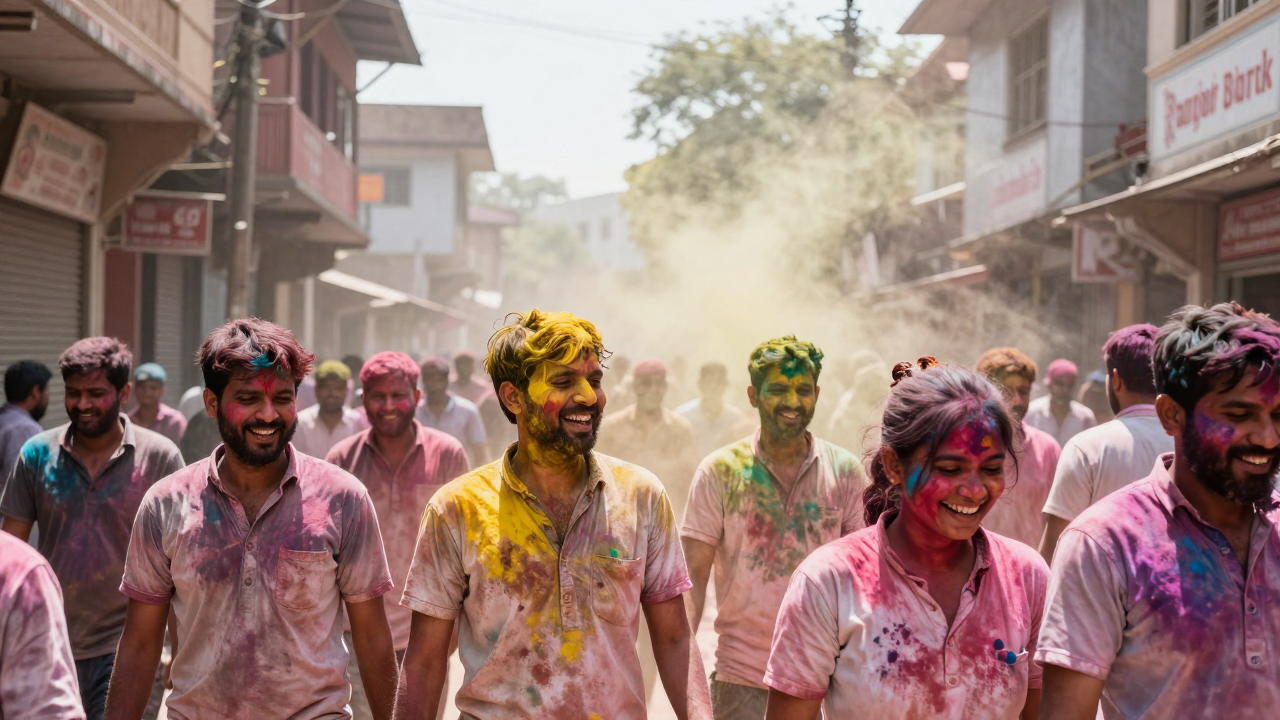
The night before. People gather in neighbourhoods and villages around a pyre of wood built over several days. After a short ritual, it is lit, and people walk around it, sing and dance, and toss in grains and other offerings. Ashes from the fire are sometimes taken home.
The morning of colours. Early in the day, people go out in old clothes, greet one another with powder on the cheeks, and then things escalate. Powders fly, water is sprayed from pichkaris (large syringes or pressurised water guns), and buckets are emptied over anyone in range. Music, drums and dancing follow. By afternoon everyone is a different colour, and many people bathe and change to visit relatives and friends in the evening.
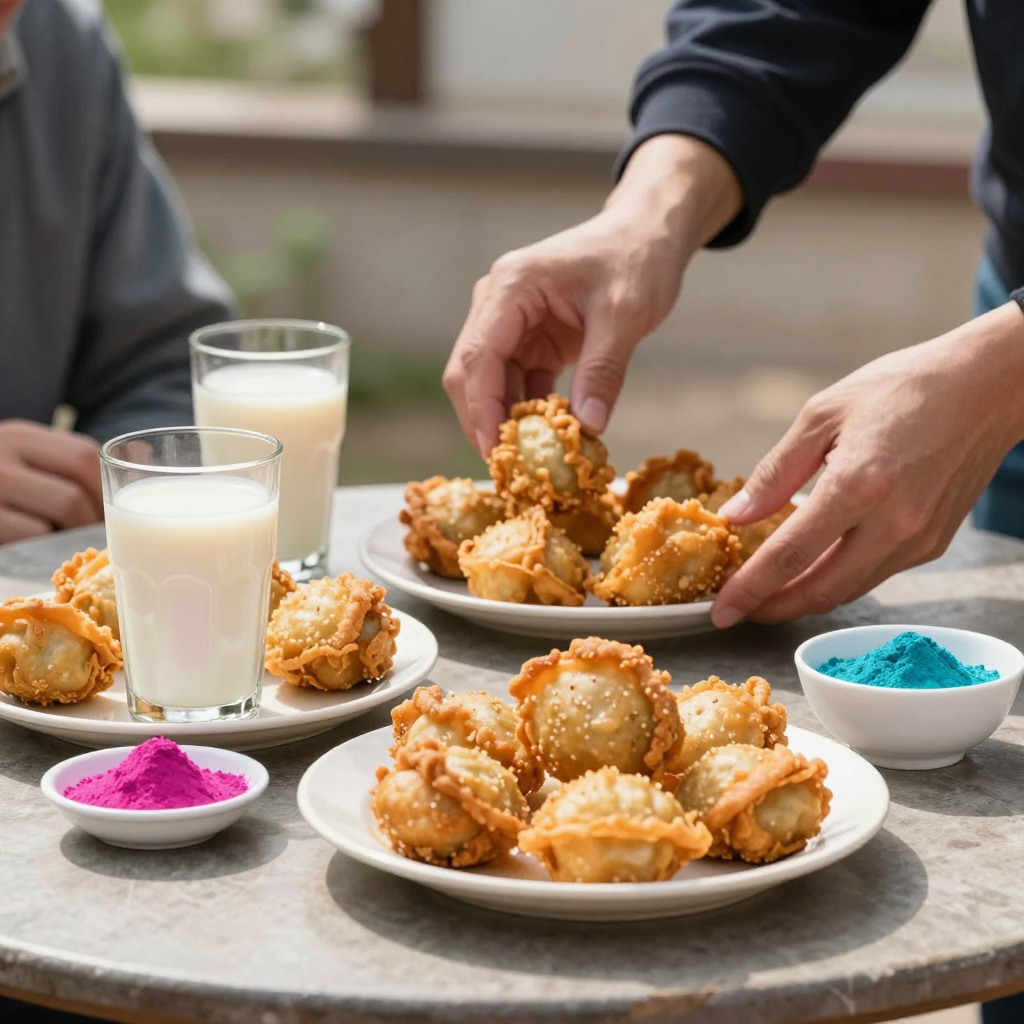
The food. Holi is a feast. Gujiya is a sweet fried dumpling stuffed with dried fruit, nuts and sweetened milk solids. Thandai is a cold drink of milk, sugar, nuts, spices and saffron. You will also find lassi, savoury snacks like pakoras and mathri, and malpua pancakes. In some regions, thandai is made with bhang, a preparation of cannabis that is legal in parts of India in this traditional setting, though anyone new to it should be cautious.
How is Holi celebrated in different places?
| Place | What is distinctive |
|---|---|
| Barsana, Uttar Pradesh | Lathmar Holi: women of Radha's village playfully beat the men of Krishna's village with wooden staves (lathis), and the men defend themselves with shields |
| Mathura and Vrindavan | Temple celebrations, flower and colour festivities linked to Krishna, spread over many days |
| West Bengal and Odisha | Dol Jatra, when idols of Krishna are carried on decorated swings; in Santiniketan, the university founded by Rabindranath Tagore, the spring festival Basanta Utsav has been held since 1923 with songs and dance |
| Nepal | Fagu Purnima: a bamboo pole with coloured cloth strips, the chir, is raised at Basantapur Durbar Square in Kathmandu about a week before the full moon; the Terai plains celebrate a day after the hills |
| Diaspora | Communities in the Caribbean (Trinidad, Guyana, Suriname), Mauritius, Fiji and South Africa carry Holi with them |
Barsana's Lathmar Holi is a story about teasing: in the legend, Krishna came from his village to tease Radha and her friends, who chased him away. Today the roles are performed with staves, songs and a lot of laughter.
Is Holi celebrated outside India, and what about Turkey?
Yes, and increasingly in a form that anyone can join. In the United States, the Sri Sri Radha Krishna Temple in Spanish Fork, Utah, holds a Festival of Colours that ISKCON News counted as its 30th annual edition in 2026, which makes it one of the earliest large colour festivals in the country. Many colour runs and colour parties in Europe and North America borrow the look of Holi, though without its religious meaning.
In Turkey, the first Holi event in its original concept, called Holifest, took place in Istanbul in April 2016, and its organisers reported around 5,000 participants. Such events usually keep the format of coloured powder, music and Indian food, without the bonfire and temple rituals. If you go, you are attending a festival inspired by Holi rather than the religious observance itself, and that is a perfectly fine thing to do as long as you understand the difference.
How can you experience Holi respectfully?
- Learn what it is. It is a Hindu religious festival first, so a little background makes the day richer, and avoids treating it as costume party.
- Ask before you colour someone. Holi's spirit is playful, but not everyone wants to be sprayed. Consent matters, especially in crowds, and rough behaviour is not part of the tradition.
- Choose natural colours. Many commercial powders contain synthetic dyes and sometimes harmful metals or abrasive additives, which can irritate skin and eyes and add fine particles to the air. Colours made from turmeric, beetroot, marigold, spinach or hibiscus are gentler. Herbal gulal is widely sold.
- Protect yourself. Wear old clothes, rub oil on skin and hair beforehand, wear glasses or goggles, and avoid contact lenses. Do not throw water balloons hard at someone's face; they can cause eye and ear injuries.
- Look after your phone and camera. Put them in a sealed bag.
- Mind water. Holi is playful with water, and in dry regions many people now prefer dry powder.
FAQ
When is Holi in 2027?
Holika Dahan, the bonfire, is on 21 March 2027 and the main colour day, Rangwali Holi, is on 22 March, going by the standard Indian calendars. The exact day can differ by a day depending on the region.
What is the difference between Holi and a colour run?
Holi is a religious and cultural festival with a bonfire ritual, stories, food and family visits, held once a year on the full moon of Phalguna. A colour run is a sporting event where runners are sprayed with powder along a course; it borrows the visuals but not the meaning.
Do you have to be Hindu to join in?
In India, Holi is enjoyed by many people beyond the Hindu community, and visitors are usually welcomed. Just approach it with respect for its religious background and follow local customs.
Is Holi colour safe?
Not always. Synthetic colours may contain harmful substances and irritate the skin and eyes. Herbal or natural colours from turmeric, beetroot or flowers are the safer choice, and it is sensible to shield your eyes.
A colourful start to spring
Holi is, at heart, about renewal: the fire burns away what is old, and the colours announce that something new is starting. Whether you go to a temple town in Uttar Pradesh, a square in Kathmandu or a colour festival closer to home, go with curiosity and a little care. To find festivals and gatherings near you, browse takvim.in and see what is on the calendar.