Every year, for nine days around the end of summer, a city of tens of thousands of people appears on a dry lakebed in Nevada, and then disappears again without leaving a trace. It has streets named after a clock face, a wooden figure that is set on fire, and almost no shops. The city is Black Rock City, the event is Burning Man, and on takvim.in we keep coming back to it because it is one of the strangest and most influential recurring gatherings in the world.
Key takeaways
- Burning Man is a temporary city built in the Black Rock Desert, Nevada, held each year for nine days ending on the US Labor Day holiday.
- It began in 1986 on Baker Beach in San Francisco, moved to the desert in 1990, and reached about 78,850 participants in 2019.
- It runs on ten principles, including gifting, radical self-reliance and leaving no trace, and cash between participants is discouraged.
- The wooden Man burns on the second-to-last night; the Temple, a memorial and reflection space, burns on the last.
- You do not have to travel to Nevada to touch the culture: regional events endorsed by the Burning Man Project run around the world.
What is Burning Man?
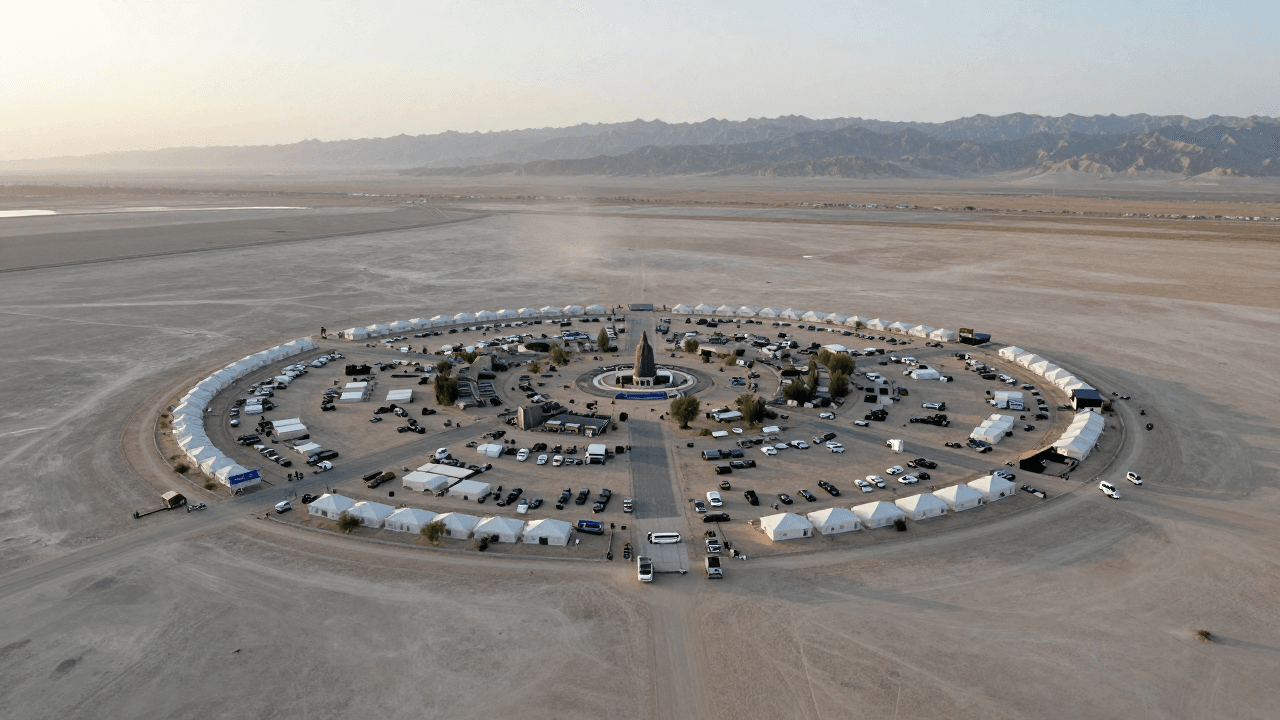
Burning Man is an annual event and a community, held in the Black Rock Desert, roughly 100 miles (160 km) north-northeast of Reno, Nevada. For nine days a temporary city, Black Rock City, is built from nothing on a vast, flat, dry lakebed that participants call the playa (Spanish for beach or shore). At its peak the city is home to tens of thousands of people, and when it is over, volunteers spend weeks working to return the land to how it was.
It is often described as a festival, but that word is only partly right. There is no headline stage that everyone faces. Music, art, food, workshops, games and rituals are created by the participants themselves, in themed camps, on decorated vehicles and in giant sculptures spread across the city. The organisers prefer the word "participant" to "attendee" for exactly this reason: the idea is that you are meant to contribute something, not just consume.
The name comes from the ritual at its centre. A large wooden effigy, the Man, stands in the middle of the city all week and is burned on the second-to-last night of the event. Nearly everything else is built around the question of what people will do when they are given an empty desert, a few rules and each other.
Where does Burning Man come from?
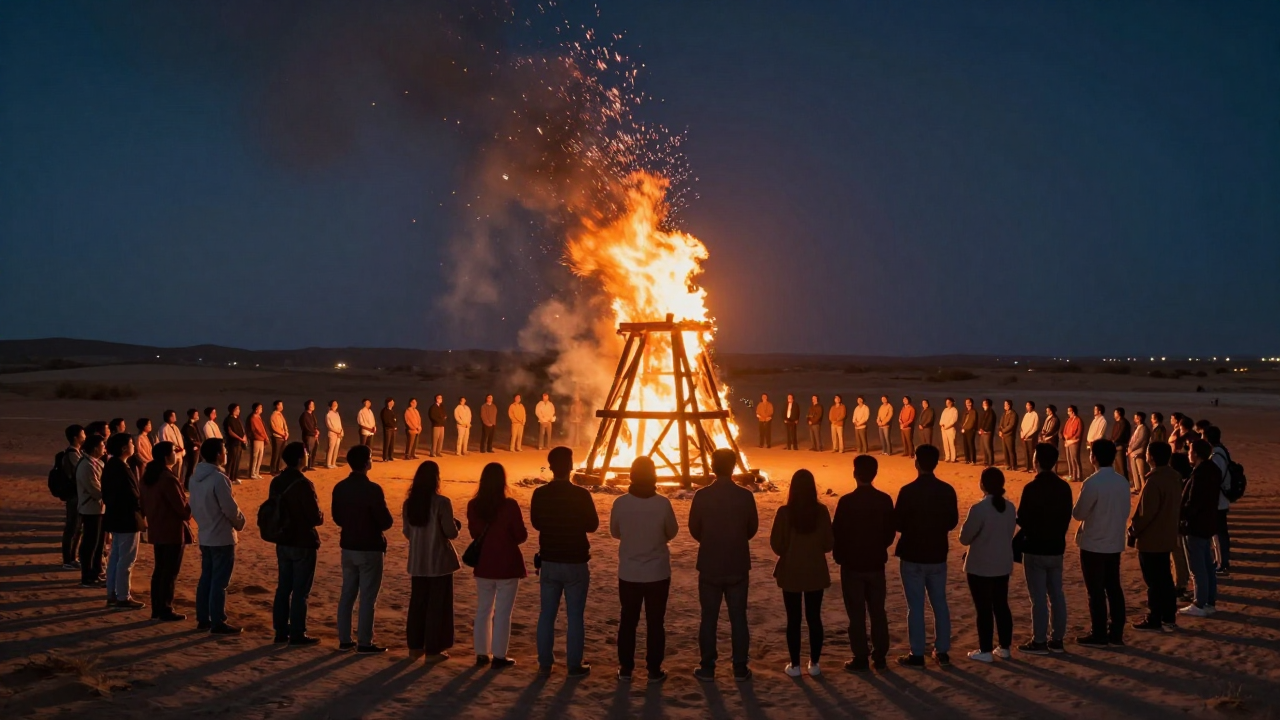
The story starts on 22 June 1986 at Baker Beach in San Francisco, where Larry Harvey and Jerry James built a wooden figure and burned it at the summer solstice, with a small crowd watching, about twenty people by most accounts. Over the following years the effigy grew, and so did the crowd. In 1990 the police stopped the burn of a much taller figure, roughly 40 feet, on the beach, and the event moved that year to the Black Rock Desert, where it was held over the Labor Day weekend in early September.
From there it grew from a countercultural bonfire into a planned city. A street plan was designed in the 1990s, a permit system was set up, and the organisation went through several forms: it was run as a private company from 1999, and in December 2013 it was handed to a non-profit, the Burning Man Project, which today runs the event and supports the regional events that use its name and principles.
Two dates are worth remembering. In 2000 the first Temple was built on the playa by the artist David Best and his collaborators; it became a memorial for a friend who had died, and visitors began leaving their own tributes to lost loved ones. And in 2020 and 2021 the desert event was cancelled for the first time in its history because of the COVID-19 pandemic; the community moved online for those two years.
When and where is Burning Man held?
Burning Man is held every year in late summer, over nine days that end on the US Labor Day holiday (the first Monday of September). The gates usually open on the last Sunday of August, so the dates move by a few days from year to year. The 2019 edition, for example, was themed Metamorphoses, and about 78,850 people took part, one of the busiest years in the event's history.
The location is fixed. Black Rock City sits on public land in Pershing County, Nevada, and the setting is part of the experience: a bleached, flat horizon in every direction, a sky with almost no light pollution, and a fine alkaline dust that gets into everything. Whiteouts, when a dust storm hides the city, are a normal part of the week, and so is a sudden cold night after a hot day.
The city is not chaotic. It is laid out as a wide arc, about 240 degrees, with the Man at its centre. Streets running in rings are named each year according to that year's theme, and radial streets are named after positions on a clock face. An address such as 6:00 and a lettered ring gives you a location that anyone can find. The speed limit for the vehicles that are allowed in is 5 mph (8 km/h).
What actually happens there?
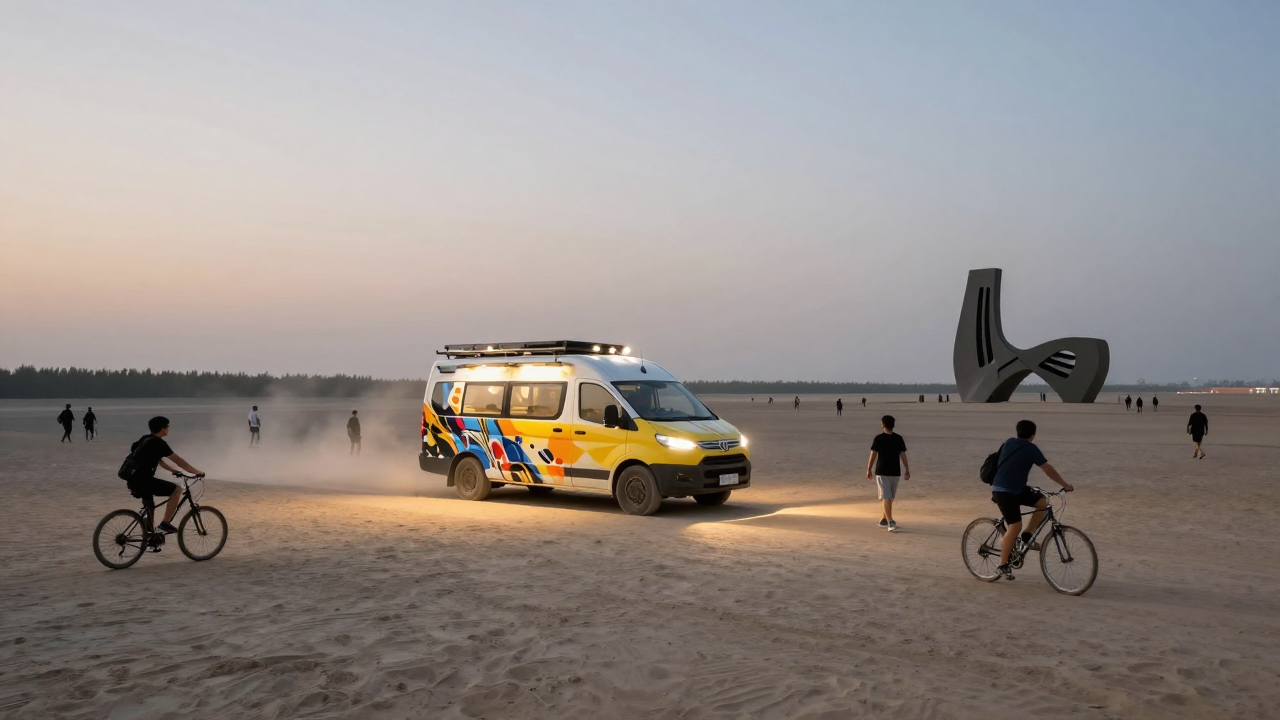
There is no single schedule. A printed and digital guide lists thousands of items created by participants, from yoga at dawn to dance parties that end at sunrise, from tea ceremonies to lectures, from mutant vehicles (art cars, called that because they are transformed into moving sculptures) to workshops on building things. Large-scale art is built across the open desert, and much of it is meant to be climbed on, walked into or, at the end, burned.
The week has a rhythm. Early days are about arriving, building camps and exploring. The Man burns on the Saturday night, in front of a crowd that surrounds it in a huge circle. The Temple burns on the final night, and it is usually a quiet ceremony rather than a party: people write messages, leave photographs and objects, and watch it burn in near silence. On the Sunday and Monday, the exodus begins, with thousands of vehicles leaving over a day or two.
Money mostly does not exist inside the city. Coffee and ice are sold at a small number of official outlets, and there are some shuttle services, but almost everything else is given or exchanged in a gifting spirit. That is not barter: a gift does not expect anything in return.
What are the 10 principles of Burning Man?
In 2004, Larry Harvey wrote down ten principles that describe the culture that had grown up around the event. They are not rules, but a description of a shared ethos, and organisers of regional events refer to them too:
- Radical inclusion: anyone may be part of Burning Man.
- Gifting: giving without an expectation of return.
- Decommodification: no sponsorships, advertising or transactions in the shared spaces.
- Radical self-reliance: discovering and relying on your own resources.
- Radical self-expression: expressing yourself in ways that respect the rights of others.
- Communal effort: valuing creative cooperation and collaboration.
- Civic responsibility: caring for public welfare and obeying the law.
- Leaving no trace: leaving the place as you found it or better.
- Participation: transformative change comes through personal participation.
- Immediacy: giving weight to direct, lived experience.
Leaving no trace is the principle that most visitors remember, because it is visible in daily life. Anything that is not part of the desert, from a bottle cap to a drop of grey water, is called MOOP, short for matter out of place. Camps are expected to pick it up, and after the event teams of volunteers walk the entire site in lines looking for what remains.
How big is Burning Man, and how has it changed?
The event is capped by its permit, and the cap has risen over the years. The organisers reported about 78,850 participants in 2019, the peak so far. Attendance has since been lower and more variable, as this short comparison shows:
| Year | Reported participants | Notes |
|---|---|---|
| 2019 | about 78,850 | Theme: Metamorphoses |
| 2020 and 2021 | none in the desert | Cancelled because of the pandemic |
| 2022 | about 75,000 | Return to the desert |
| 2023 | about 74,000 | Heavy rain and flooding closed roads during the event |
| 2024 | about 69,000 | Tickets did not sell out for the first time since 2011 |
The trend is a reminder that this is not a festival that only ever grows. Costs, travel distance, the weather and a changing audience all play a part. It also shows why it makes sense to think of Burning Man as a recurring occasion with a long history, not as a single edition.
Why does it matter beyond the desert?
Burning Man has influenced how many people think about art, festivals and community. Large interactive sculptures, participatory art, temporary public installations and the idea of gifting have all spread far beyond Nevada. Regional events, endorsed by the Burning Man Project, follow the ten principles on a smaller scale; well-known examples include AfrikaBurn in South Africa and Apogaea in Colorado. Many cities have local communities that build art, throw gatherings and prepare for the desert year-round.
It has also drawn criticism. Some people say it has become expensive and difficult to reach, and that the ideal of decommodification sits awkwardly with the costs of getting there. Others point to the environmental cost of tens of thousands of people travelling to a remote location. Both points are worth knowing before you form an opinion.
How can you experience Burning Man?
If you want to go, the first thing to know is that tickets are sold through the organisation's own sales, that there are several rounds, and that prices and rules change every year, so you should only trust the official Burning Man website. Plan well ahead: you are expected to arrive with all your food, water, shelter and shade, since there is no shop to fall back on.
If you do not want to go to Nevada, there are other routes. You can look for a regional event or a local community near you, volunteer at an art project, or simply visit an interactive installation at a festival in your own city. You can also follow the summer calendar on takvim.in to see what is happening near you.
FAQ
Is Burning Man a music festival?
Not in the usual sense. Music is everywhere, from DJs on art cars to small acoustic sets, but there is no main stage and no line-up. It is a participatory event, and much of what happens is made by attendees.
Why do they burn the Man?
The burn is the ritual centre of the event and gives it its name. Its meaning is left open, and people read it as a shared release, a celebration or a moment of reflection. The Temple burn on the last night carries a more personal, memorial meaning.
Do you have to bring everything with you?
Almost everything, yes. The organisers provide basic services such as portable toilets and medical care, and a few outlets sell ice and coffee, but food, water, shelter and shade are your own responsibility. This is what the principle of radical self-reliance means in practice.
Can you go to Burning Man in Turkey or Europe?
The original event happens only in Nevada, but the Burning Man Project endorses regional events in many countries. Check the official regional list for what is currently active near you.
Conclusion
Burning Man is hard to describe because it is built by the people who come, and it changes every year. What stays constant is the idea: a city with no audience, in which you bring something to share and leave nothing behind. If you want to find festivals, gatherings and events near you, takvim.in is a good place to start.