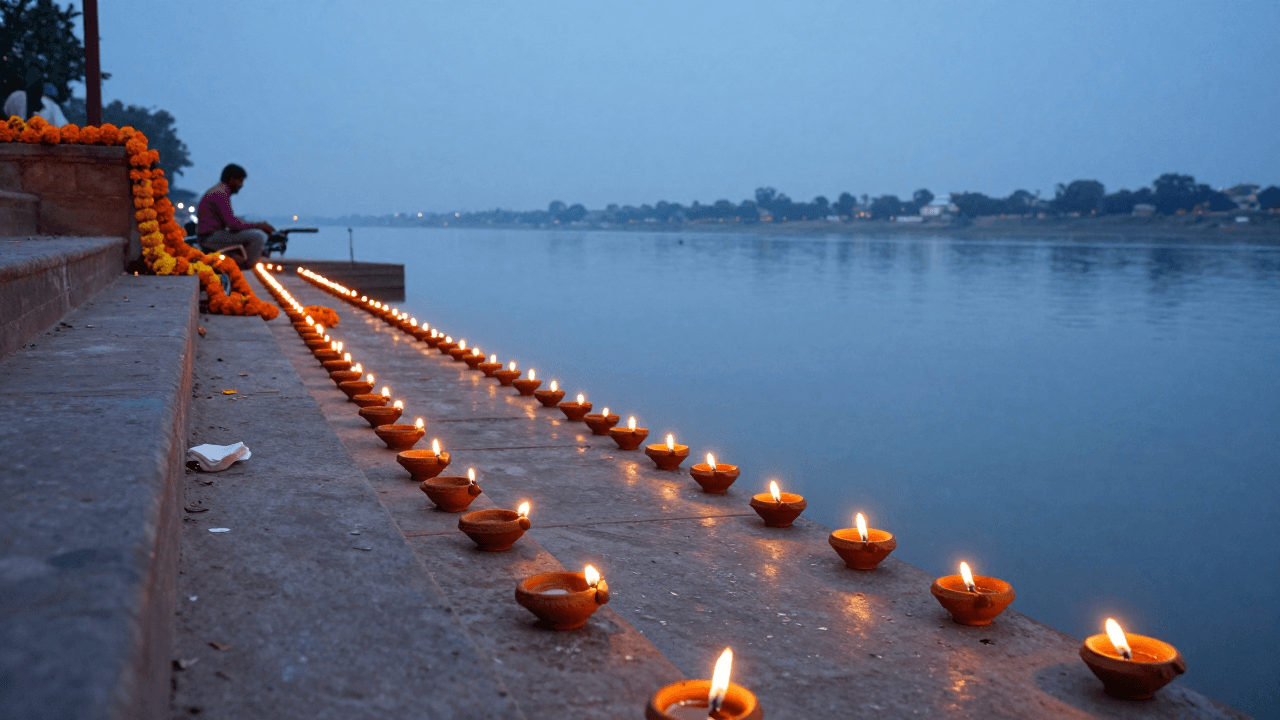
On a dusk by a river, someone lights the first clay lamp on a stone step. Then ten more, then hundreds, until the water's edge becomes a line of flame. For Hindu, Jain and Sikh communities around the world, one of the brightest nights of the year has begun: Diwali. In 2026 the main night falls on Sunday, 8 November, roughly three weeks away. At takvim.in, where we keep an events calendar, the question behind this post is simple: why does a festival sit on one particular night, and what happens on it?
Key points
- Diwali (Deepavali) is a festival of lights in the Hindu lunisolar months of Ashvin and Kartika, roughly mid-October to mid-November; the main day is the new-moon night (amavasya).
- It usually lasts five or six days. In 2026 it opens on 6 November with Dhanteras and closes on 10 November with Bhai Dooj.
- Hindus, Jains and Sikhs give the festival different meanings; the shared thread is light, cleaning and sharing.
- UNESCO inscribed Diwali on its Representative List of the Intangible Cultural Heritage of Humanity on 10 December 2025.
What exactly is Diwali?
Diwali, often called Deepavali, is among the most widely observed festivals of Indian culture. Because it follows a lunisolar calendar it has no fixed Gregorian date: it sits on the new-moon night where Ashvin meets Kartika. The main day is 8 November in 2026; the next ones listed are 29 October 2027 and 17 October 2028. "Late October or early November" is the honest summary for anyone who does not follow the Hindu calendar.
Light is the centre: homes, temples and workplaces are lit with oil lamps (diyas), candles and lanterns. Behind the light is a widely shared idea, the victory of light over darkness and good over evil, which is how UNESCO describes it too.
Five days, five scenes
Diwali is not one night; it is a run of days around the main night, five or six depending on region. For 2026:
| Date (2026) | Day | In short |
|---|---|---|
| 6 November | Dhanteras / Yama Deepam | The opening, two days before the main night |
| 7 November | Naraka Chaturdashi / Chhoti Diwali | "Little Diwali"; in some traditions the day Krishna defeated the demon Narakasura |
| 8 November | Lakshmi Puja | The main day; prayers to Lakshmi, goddess of wealth |
| 9 November | Govardhan Puja / Balipratipada | The following day |
| 10 November | Bhai Dooj / Vishwakarma Puja | A day of siblings |
The festival starts two days before the new moon and runs to the second day of Kartik (some sources count the 17th day). Because the maths is lunar, different panchang (Hindu almanac) publishers give puja times that differ by minutes or hours, and the exact Lakshmi Puja time depends on the city, so anyone planning to pray should check a local panchang. Some pages give a different main day, but most sources agree on 8 November.
Why is Diwali celebrated? Several stories
There is no single answer, and that plurality is the festival's strength.
Rama's return (Hindu). The best-known story is the Ramayana: after fourteen years of exile and the defeat of Ravana, Rama returns to Ayodhya with Sita and Lakshmana, and the city is lit with lamps to welcome them. Hanuman is part of that homecoming.
Lakshmi and Krishna. The festival is widely linked with Lakshmi, goddess of wealth, hence the name Lakshmi Puja. In some traditions the day before is remembered for Krishna's defeat of Narakasura.
Kali in the east. Hindus in eastern India and Bangladesh generally worship Kali during Diwali, so on the same night lamps burn for Lakshmi in one place and Kali in another.
Newar Buddhists. In Nepal, Newar Buddhists celebrate by worshipping Lakshmi.
Jains. For Jains, Diwali marks Mahavira's final nirvana, traditionally dated 527 BCE.
Sikhs. Sikhs call it Bandi Chhor Divas, marking Guru Hargobind's release from Gwalior Fort, where the Mughal emperor Jahangir had imprisoned him.
So calling Diwali "the festival of one story" falls short. The better description: one calendar moment, loaded with different meanings by different communities.
How old is it? The written traces
Exactly when Diwali began cannot be said, but there are written traces. The Padma Purana and Skanda Purana mention it, both dated between the 7th and 10th centuries. Harsha's 7th-century Sanskrit play Nagananda refers to it. Rajasekhara's 9th-century Kavyamimamsa describes houses and markets decorated with oil lamps. A 10th-century copper plate of the Rashtrakuta king Krishna III (939-967 CE) and a 10th-century Jain inscription at Saundatti mention Dipotsava. Al Biruni wrote about it in the 11th century.
That list avoids "thousands of years" rhetoric and shows what we can actually point to: the earliest records reach back roughly a thousand years.
What happens in a Diwali home?
Details vary by region and family; a few elements recur:
- Lamps and light. Diyas, candles and lanterns light the home, temple and workplace.
- Dawn oil bath. Hindus take a ritual oil bath at dawn on each day of the festival.
- Rangoli. Geometric patterns drawn on the floor with coloured powder and petals, usually at the door.
- Fireworks. The loud and bright side of the festival, though rules and air quality are debated in many cities, so check local regulations.
- Food and sweets. Family visits, feasts and sharing mithai (Indian sweets) are the heart of it.
 )
A rangoli's charm is that it is temporary: made with care in an evening, scuffed away by footsteps the next day. Diwali is less about monuments than about making a shared moment.
Where is it a public holiday?
Diwali is not only India's festival. On the main day it is an official holiday in Fiji, Guyana, India, Malaysia, Mauritius, Myanmar, Nepal, Pakistan, Singapore, Sri Lanka, Suriname, and Trinidad and Tobago. In the United States, Connecticut, Pennsylvania and California recognise it symbolically.
The UNESCO listing
On 10 December 2025 Deepavali was inscribed on UNESCO's Representative List of the Intangible Cultural Heritage of Humanity. It became India's 16th element on the list, one of 24 inscriptions that day. The intergovernmental committee met at the Red Fort in India from 8 to 13 December 2025, with delegates from 194 member states. The decision does not change how the festival is practised, but it makes it more visible as recognised world heritage.
If you are in Turkey
We cannot say Diwali has a broad public celebration in Turkey, and it is better to say so than to invent data. Still, it matters for three reasons.
First, cultural literacy: if you work or live alongside Hindu colleagues or neighbours, you will want to know to say "Happy Diwali" in early November. Second, travel: for anyone heading to India, Nepal, Singapore or Sri Lanka in early November, the main day is 8 November and an official holiday there, so expect official offices to be closed. Third, events culture: seeing why a festival sits on a particular calendar moment changes how you look at festivals at home.
 on a brass tray beside lit clay lamps and marigolds](https://supabase.takvim.in/storage/v1/object/public/cms/blog/2026/11f04e2d-a570-4091-8f68-6ac3d8ca093f.png) )
If you are invited to a Diwali gathering, since sharing sweets is central, bringing a small treat is a reasonable gesture. Beyond that I will not invent rules: customs differ by family and region, and asking is best.
Frequently asked questions
When is Diwali in 2026?
The main day is Sunday, 8 November 2026. The five-day celebration opens with Dhanteras on 6 November and closes with Bhai Dooj on 10 November.
Which religion celebrates Diwali?
More than one: Hindus, Jains and Sikhs celebrate it, and Newar Buddhists in Nepal take part. Each community remembers a different story.
Why does the date change every year?
It follows a lunisolar calendar. The festival sits on the new-moon night and drifts across the Gregorian calendar.
What do people eat at Diwali?
There is no single menu, but feasts and sharing mithai are an unchanging part of it.
Closing
Diwali is a story about light inside the calendar: small lamps against the darkness of a new-moon night. Communities from India to Singapore load the same night with different stories, and UNESCO now recognises it as world heritage. To follow other festivals in the months ahead, browse takvim.in; there you can find concerts, festivals, exhibitions and workshops near you, and if you are an organiser you can publish your own event on takvim.in.